주메뉴
- About IBS 연구원소개
-
Research Centers
연구단소개
- Research Outcomes
- Mathematics
- Physics
- Center for Underground Physics
- Center for Theoretical Physics of the Universe (Particle Theory and Cosmology Group)
- Center for Theoretical Physics of the Universe (Cosmology, Gravity and Astroparticle Physics Group)
- Dark Matter Axion Group
- Center for Artificial Low Dimensional Electronic Systems
- Center for Quantum Nanoscience
- Center for Exotic Nuclear Studies
- Center for Van der Waals Quantum Solids
- Center for Relativistic Laser Science
- Center for Trapped Ion Quantum Science
- Chemistry
- Life Sciences
- Center for Memory and Glioscience (Cognitive Glioscience Group)
- Center for Memory and Glioscience (Learning and Memory Group)
- Center for Synaptic Brain Dysfunctions
- Center for RNA Research
- Center for Genomic Integrity
- Center for Vascular Research
- Center for Genome Engineering
- Center for Microbiome–Body–Brain Physiology
- Earth Science
- Interdisciplinary
- Center for Neuroscience Imaging Research (Neuro Technology Group)
- Center for Neuroscience Imaging Research (Cognitive and Computational Neuroscience Group)
- Center for Algorithmic and Robotized Synthesis
- Center for Nanomedicine
- Center for Biomolecular and Cellular Structure
- Center for 2D Quantum Heterostructures
- Institutes
- Korea Virus Research Institute
- News Center 뉴스 센터
- Career 인재초빙
- Living in Korea IBS School-UST
- IBS School 윤리경영

주메뉴
- About IBS
-
Research Centers
- Research Outcomes
- Mathematics
- Physics
- Center for Underground Physics
- Center for Theoretical Physics of the Universe (Particle Theory and Cosmology Group)
- Center for Theoretical Physics of the Universe (Cosmology, Gravity and Astroparticle Physics Group)
- Dark Matter Axion Group
- Center for Artificial Low Dimensional Electronic Systems
- Center for Quantum Nanoscience
- Center for Exotic Nuclear Studies
- Center for Van der Waals Quantum Solids
- Center for Relativistic Laser Science
- Center for Trapped Ion Quantum Science
- Chemistry
- Life Sciences
- Center for Memory and Glioscience (Cognitive Glioscience Group)
- Center for Memory and Glioscience (Learning and Memory Group)
- Center for Synaptic Brain Dysfunctions
- Center for RNA Research
- Center for Genomic Integrity
- Center for Vascular Research
- Center for Genome Engineering
- Center for Microbiome–Body–Brain Physiology
- Earth Science
- Interdisciplinary
- Center for Neuroscience Imaging Research (Neuro Technology Group)
- Center for Neuroscience Imaging Research (Cognitive and Computational Neuroscience Group)
- Center for Algorithmic and Robotized Synthesis
- Center for Nanomedicine
- Center for Biomolecular and Cellular Structure
- Center for 2D Quantum Heterostructures
- Institutes
- Korea Virus Research Institute
- News Center
- Career
- Living in Korea
- IBS School



News Center

|
What is mesoscale horizontal stirring?In the ocean’s surface layer, water is not only mixed vertically by wind and other energy sources, but also “stirred” horizontally. When this stirring occurs on horizontal scales of tens to hundreds of kilometers, it is referred to as mesoscale horizontal stirring. Unlike conventional mixing or small-scale turbulence, stirring describes a dynamical and structural horizontal rearrangement of water masses. During this process, fluid parcels are stretched into long, thin filaments and wrapped around one another. These structures can eventually generate turbulence, contributing to the mixing of temperature, nutrients, and other properties. In this sense, stirring acts as a precursor to mixing, shaping how water masses and tracers are redistributed across the ocean surface. Why is mesoscale horizontal stirring important?Mesoscale horizontal stirring plays a crucial role in transporting and redistributing heat and nutrients, thereby influencing the distribution of phytoplankton in the upper ocean. The stretching, folding, and separation of nearby fluid parcels over time also control the dispersion of fish eggs, larvae, and pollutants such as microplastics. At moderate levels, stirring can enhance connectivity between fish populations and habitats, promoting genetic exchange. However, if stirring intensifies beyond an optimal level, larvae may be transported into unsuitable environments, reducing survival rates. Therefore, future changes in mesoscale horizontal stirring may profoundly affect marine ecosystems and the spread of marine pollutants. Scientific ChallengesQuantifying how global warming affects small-scale ocean circulation and marine ecosystems in polar regions remains a major scientific challenge. Observations in these regions are limited due to difficult geographic access, restricted ship-based measurements, and constraints on satellite monitoring. As a result, climate scientists rely heavily on numerical climate models. However, the spatial resolution of most current-generation climate models is insufficient to explicitly simulate mesoscale processes, turbulence, and horizontal mixing in the ocean. To overcome this limitation, the IBS research team analyzed results from an ultra-high-resolution global warming experiment conducted using the IBS supercomputer ALEPH. The simulations were performed with the Community Earth System Model version 1.2.2 (CESM-UHR), a fully coupled atmosphere–sea ice–ocean climate model. The model employs a horizontal resolution of 0.25° in the atmosphere and 0.1° in the ocean, allowing a more realistic representation of interactions within the climate system. This study is the first to systematically evaluate future changes in oceanic horizontal stirring at the global scale using an ultra-high-resolution coupled Earth system model. The research was led by YI Gyuseok, a Ph.D. student in the Interdisciplinary Program in Climate System at Pusan National University.
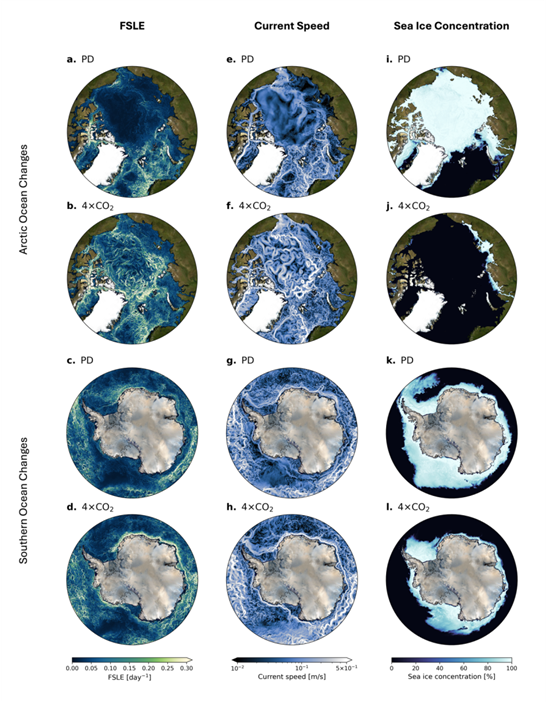
Response of Mesoscale Horizontal Stirring to Global WarmingThe study compared simulations under present-day CO₂ levels, doubled CO₂, and quadrupled CO₂ conditions to examine how anthropogenic global warming influences mesoscale horizontal stirring. To quantify the stretching of fluid parcels into elongated filament structures, the researchers used the Finite-Size Lyapunov Exponent (FSLE). FSLE measures how rapidly neighboring water parcels separate due to mesoscale ocean eddies, meandering currents, and oceanic fronts over distances of tens to hundreds of kilometers. Larger FSLE values indicate more rapid separation and stronger surface stirring. Mechanisms Driving Intensification of Polar Ocean StirringThe analysis revealed that mesoscale horizontal stirring is projected to intensify markedly along the Arctic and Antarctic coastal regions under global warming (Figure 1). This intensification is primarily driven by rapid sea-ice decline, but the underlying mechanisms differ between the Arctic and Antarctic. In the Arctic Ocean, the loss of sea ice increases the amount of mechanical energy transferred from the atmosphere to the ocean. Without the damping effect of sea ice, lower-atmospheric winds more effectively strengthen mean ocean currents, enhance surface eddy activity, and intensify mesoscale horizontal stirring and turbulence. In contrast, along the Antarctic coast, sea-ice decline leads to enhanced coastal freshening. This freshening strengthens meridional (north–south) density gradients in seawater, which in turn intensifies coastal currents and mesoscale horizontal stirring. Future Research DirectionsThe projected strengthening of mesoscale horizontal stirring in polar oceans could significantly alter marine ecosystems and the dispersion of pollutants. Further research is urgently needed to assess these ecological implications. To better understand ecosystem responses, additional ultra-high-resolution Earth system model simulations incorporating plankton and fish population models will be required. The IBS Center for Climate Physics, led by Director Axel TIMMERMANN, is currently developing a next-generation Earth system model that more effectively integrates interactions between climate and life. This framework is expected to deepen our understanding of how polar ecosystems will respond to ongoing global warming. |
| Next | |
|---|---|
| before |
- Content Manager
- Public Relations Team : Suh, William Insang 042-878-8137
- Last Update 2023-11-28 14:20
55, Expo-ro, Yuseong-gu, Daejeon, Korea, 34126
Tel. +82-42-878-8114 | Fax. +82-42-878-8079 | E-mail. webmaster@ibs.re.kr
Copyright(c) IBS. All Rights Reserved.