주메뉴
- About IBS 연구원소개
-
Research Centers
연구단소개
- Research Outcomes
- Mathematics
- Physics
- Center for Underground Physics
- Center for Theoretical Physics of the Universe (Particle Theory and Cosmology Group)
- Center for Theoretical Physics of the Universe (Cosmology, Gravity and Astroparticle Physics Group)
- Dark Matter Axion Group
- Center for Artificial Low Dimensional Electronic Systems
- Center for Quantum Nanoscience
- Center for Exotic Nuclear Studies
- Center for Van der Waals Quantum Solids
- Center for Relativistic Laser Science
- Center for Trapped Ion Quantum Science
- Chemistry
- Life Sciences
- Center for Memory and Glioscience (Cognitive Glioscience Group)
- Center for Memory and Glioscience (Learning and Memory Group)
- Center for Synaptic Brain Dysfunctions
- Center for RNA Research
- Center for Genomic Integrity
- Center for Vascular Research
- Center for Genome Engineering
- Center for Microbiome–Body–Brain Physiology
- Earth Science
- Interdisciplinary
- Center for Neuroscience Imaging Research (Neuro Technology Group)
- Center for Neuroscience Imaging Research (Cognitive and Computational Neuroscience Group)
- Center for Algorithmic and Robotized Synthesis
- Center for Nanomedicine
- Center for Biomolecular and Cellular Structure
- Center for 2D Quantum Heterostructures
- Institutes
- Korea Virus Research Institute
- News Center 뉴스 센터
- Career 인재초빙
- Living in Korea IBS School-UST
- IBS School 윤리경영

주메뉴
- About IBS
-
Research Centers
- Research Outcomes
- Mathematics
- Physics
- Center for Underground Physics
- Center for Theoretical Physics of the Universe (Particle Theory and Cosmology Group)
- Center for Theoretical Physics of the Universe (Cosmology, Gravity and Astroparticle Physics Group)
- Dark Matter Axion Group
- Center for Artificial Low Dimensional Electronic Systems
- Center for Quantum Nanoscience
- Center for Exotic Nuclear Studies
- Center for Van der Waals Quantum Solids
- Center for Relativistic Laser Science
- Center for Trapped Ion Quantum Science
- Chemistry
- Life Sciences
- Center for Memory and Glioscience (Cognitive Glioscience Group)
- Center for Memory and Glioscience (Learning and Memory Group)
- Center for Synaptic Brain Dysfunctions
- Center for RNA Research
- Center for Genomic Integrity
- Center for Vascular Research
- Center for Genome Engineering
- Center for Microbiome–Body–Brain Physiology
- Earth Science
- Interdisciplinary
- Center for Neuroscience Imaging Research (Neuro Technology Group)
- Center for Neuroscience Imaging Research (Cognitive and Computational Neuroscience Group)
- Center for Algorithmic and Robotized Synthesis
- Center for Nanomedicine
- Center for Biomolecular and Cellular Structure
- Center for 2D Quantum Heterostructures
- Institutes
- Korea Virus Research Institute
- News Center
- Career
- Living in Korea
- IBS School



News Center

| Title | Leading research on the aging and lifespan of native plants | ||||
|---|---|---|---|---|---|
| Name | Department of Communications | Registration Date | 2014-04-01 | Hits | 1594 |
| att. |
 aging1.jpg
|
||||
|
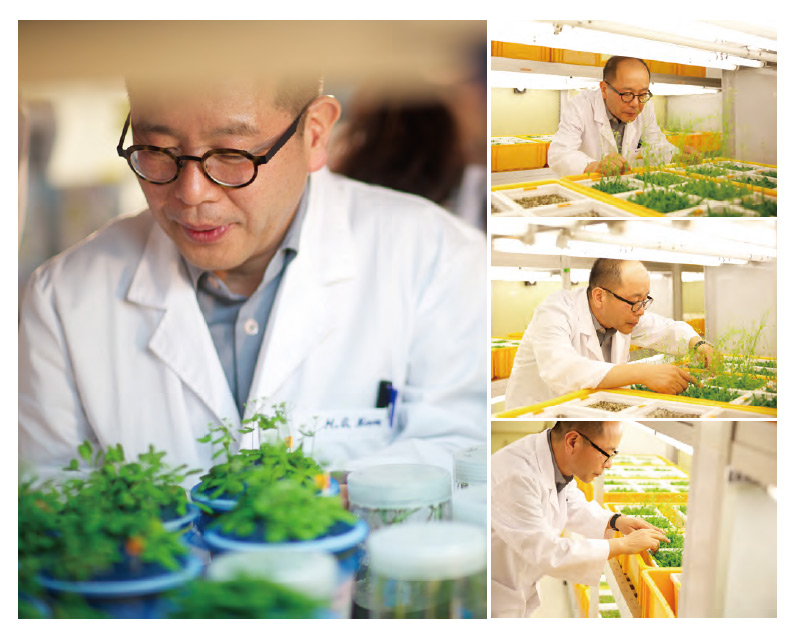
Leading the world with research on the aging and lifespan of native plantsHong Gil Nam, the Director of Center for Plant Aging Research at IBS “I am the first botanist to receive one of the major Korean science awards. In a sense, botany can be deemed an unpopular area, and yet this honor shows us that perseverance and dedication can lead to success. I believe that this award means a great deal of encouragement not just to me, but also to any people who pursue basic science” said Hong Gil Nam, the director of the Center for Plant Aging Research at IBS, and a professor at the Daegu Gyeongbuk Institute of Science and Technology (DGIST) during this interview about the meaning of his 24th Hoam Prize winning on 30th May. Selected as the top national scientist in 2010 and also as a director of the Center for Plant Aging Research at IBS in 2012, Director Nam has now been recognized as a world-leading scientist who has explored a new field of study with his research on plant aging and plant development and growth control. And the Hoam Prize gave momentum to him. “I have gained overseas recognition for the domestic research. I think this prize is the signal for next step of my work,” Nam said. From the riverside memories to the field of systemic biology“How do plants know when to blossom and wither away?” Director Nam had many of these types of questions from his childhood. Living beside the Nakdong River in Gimhae County, Gyeongnam Province, he spent a lot of time with plants. He was amazed by the fact that plants thrived without any kind of human intervention. Living in the countryside, his playground was meadows, with trees and all kinds of flora. Walking down the lane across a rice field, he was unknowingly in tune with their existence. When asked about what made him research plants rather than animals, Dr. Nam remembered the early days of his postdoctoral studies. As an undergraduate in college he majored in chemistry and later studied the molecular genetics of yeast. What is aging?“There are many theories explaining the aging process. What I am saying might be only one of the traits of which the condition of aging is comprised. I believe that aging is one of life’s primary ‘programs.’ Aging is not a degeneration or regression but rather a conversion of function that aligns with the corresponding age.” Dr. Nam suggested that we should not perceive the term ‘aging’ negatively. “I realized this while studying,” he added, “I considered it thoroughly when I reviewed my 2009 research paper published in Science.” On 20th February of that year, led by Dr. Nam, reported that aging is regulated via complex circuit including multiple proteins and enzymes, not one molecule or gene. Dr. Nam’s research team investigated the molecular mechanisms of aging with Arabidopsis thaliana, commonly called mouse-ear cress. They identified three genes, ORESARA1 (ORE1), EIN2, and miR164 as aging agents. These three genes turned out to be the bio-circuit regulating age.
Achieving a victory in scienceDr. Nam is famous, especially in Korea, for having research findings published in the three most prestigious journals of scientific community; Nature, Science, and Cell. In Science, he was featured twice, once in 2009 and once in 1999. On 3rd September 1999, while studying the plant Arabidopsis thaliana, the research team led by Dr. Nam detailed the discovery of the gene GIGANTEA which regulates the biometric clock and light periodicity. This gene is known to be concerned with controlling the blossoming period of plants. Illuminating the plant with complex systemic biologyElected as the director of the Center for Plant Aging Research at IBS in October 2012, Dr. Nam expanded his studies on the systemic biology of plants. Previously, he questioned how plants get old. Now his investigations will include how plants recognize the time as it pertains to growth and aging, He states, “Until recently, research has been fragmented. Now, I will try to view the aging process as a whole. Aging should not be regarded as a specific step but as a preserving strategy of any species. Now, we are working on a project to detail plant programs (processes) from young age until death. |
|||||
| Next | |
|---|---|
| before |
- Content Manager
- Public Relations Team : Suh, William Insang 042-878-8137
- Last Update 2023-11-28 14:20
55, Expo-ro, Yuseong-gu, Daejeon, Korea, 34126
Tel. +82-42-878-8114 | Fax. +82-42-878-8079 | E-mail. webmaster@ibs.re.kr
Copyright(c) IBS. All Rights Reserved.