주메뉴
- About IBS 연구원소개
-
Research Centers
연구단소개
- Research Outcomes
- Mathematics
- Physics
- Center for Underground Physics
- Center for Theoretical Physics of the Universe (Particle Theory and Cosmology Group)
- Center for Theoretical Physics of the Universe (Cosmology, Gravity and Astroparticle Physics Group)
- Dark Matter Axion Group
- Center for Artificial Low Dimensional Electronic Systems
- Center for Quantum Nanoscience
- Center for Exotic Nuclear Studies
- Center for Van der Waals Quantum Solids
- Center for Relativistic Laser Science
- Center for Trapped Ion Quantum Science
- Chemistry
- Life Sciences
- Center for Memory and Glioscience (Cognitive Glioscience Group)
- Center for Memory and Glioscience (Learning and Memory Group)
- Center for Synaptic Brain Dysfunctions
- Center for RNA Research
- Center for Genomic Integrity
- Center for Vascular Research
- Center for Genome Engineering
- Center for Microbiome–Body–Brain Physiology
- Earth Science
- Interdisciplinary
- Center for Neuroscience Imaging Research (Neuro Technology Group)
- Center for Neuroscience Imaging Research (Cognitive and Computational Neuroscience Group)
- Center for Algorithmic and Robotized Synthesis
- Center for Nanomedicine
- Center for Biomolecular and Cellular Structure
- Center for 2D Quantum Heterostructures
- Institutes
- Korea Virus Research Institute
- News Center 뉴스 센터
- Career 인재초빙
- Living in Korea IBS School-UST
- IBS School 윤리경영

주메뉴
- About IBS
-
Research Centers
- Research Outcomes
- Mathematics
- Physics
- Center for Underground Physics
- Center for Theoretical Physics of the Universe (Particle Theory and Cosmology Group)
- Center for Theoretical Physics of the Universe (Cosmology, Gravity and Astroparticle Physics Group)
- Dark Matter Axion Group
- Center for Artificial Low Dimensional Electronic Systems
- Center for Quantum Nanoscience
- Center for Exotic Nuclear Studies
- Center for Van der Waals Quantum Solids
- Center for Relativistic Laser Science
- Center for Trapped Ion Quantum Science
- Chemistry
- Life Sciences
- Center for Memory and Glioscience (Cognitive Glioscience Group)
- Center for Memory and Glioscience (Learning and Memory Group)
- Center for Synaptic Brain Dysfunctions
- Center for RNA Research
- Center for Genomic Integrity
- Center for Vascular Research
- Center for Genome Engineering
- Center for Microbiome–Body–Brain Physiology
- Earth Science
- Interdisciplinary
- Center for Neuroscience Imaging Research (Neuro Technology Group)
- Center for Neuroscience Imaging Research (Cognitive and Computational Neuroscience Group)
- Center for Algorithmic and Robotized Synthesis
- Center for Nanomedicine
- Center for Biomolecular and Cellular Structure
- Center for 2D Quantum Heterostructures
- Institutes
- Korea Virus Research Institute
- News Center
- Career
- Living in Korea
- IBS School



News Center

Sensitivity of Antarctic Ice to Climate Change Sharply Increased After Ice Age Shift 1 Million Years AgoA new study published in the journal Nature Geoscience [1] by researchers at the IBS Center for Climate Physics (ICCP) at Pusan National University in South Korea shows that the Antarctic ice sheet became more sensitive to climate forcing following a major shift in Earth’s ice age cycles about one million years ago, providing new insight into how ice sheets respond to long-term climate change. Antarctica currently holds the largest ice mass on Earth and plays a key role in global sea level change. About one million years ago, Earth’s climate system underwent a major shift, with ice ages becoming longer and more intense. This transition, known as the Mid-Pleistocene Transition, fundamentally altered the behavior of large ice sheets, yet how they responded to this change remains poorly understood. A key challenge has been the lack of long-term, realistic temperature and precipitation data needed to run ice sheet models under such conditions. To overcome this limitation, the researchers used a realistic paleoclimate computer simulation [2], recently conducted at the ICCP, that reproduces the global climate history over the last 3 million years. Temperature and rainfall data from this simulation were then used as input for the Penn State University ice-sheet–ice-shelf model. This model simulates changes in ice sheet flow, temperature, and height for the Northern Hemisphere ice sheets and Antarctica. It also captures the dynamics and movement of floating ice shelves, such as in the Ross and Weddell Seas. Running the ice-sheet model on one of South Korea’s fastest computers dedicated to basic science, the researchers obtained a physically consistent and spatially continuous representation of the global ice-sheet evolution under time-evolving climate conditions. The simulation reveals that following the Mid-Pleistocene Transition, the Antarctic ice sheet entered a new dynamical regime. In particular, the results identify a critical atmospheric CO2 level of around 240 parts per million, below which the amplitude of Antarctic ice variations suddenly increases in response to changes in atmospheric and ocean temperatures (Fig. 1). “After this transition, the Antarctic ice sheet reacts much more strongly to changes in climate forcing. This indicates that the system does not evolve gradually but instead becomes more responsive after crossing a particular threshold in the climate system,” said Dr. YUN Kyung-Sook, researcher at the IBS Center for Climate Physics and lead author of the study. In the computer model simulation, the accelerated Antarctic ice growth after the 1 million years ago can be attributed to a combination of factors: i) colder glacial ocean temperatures, which reduce melting of the Antarctic ice sheet below sea level, ii) lower global sea level (~50-100 m below present), which reduces the pressure on the bedrock below the ice shelves, leading to a slow uplift which further promotes ice thickening along the coast of Antarctica. Working in unison, these processes helped establish the larger and more persistent Antarctic ice sheets characteristic of later ice age cycles (Fig. 2). “Our findings suggest that the Antarctic ice sheet was more sensitive to external forcings than previously assumed. This also raises important questions about its future response to global warming,” said Prof. Axel TIMMERMANN, Director of the IBS Center for Climate Physics and co-author of the study. The study highlights that ice sheets do not respond linearly to climate forcing but instead can undergo sharp shifts that drastically alter their sensitivity to external factors. Understanding these changes is critical for improving projections of future sea level rise. 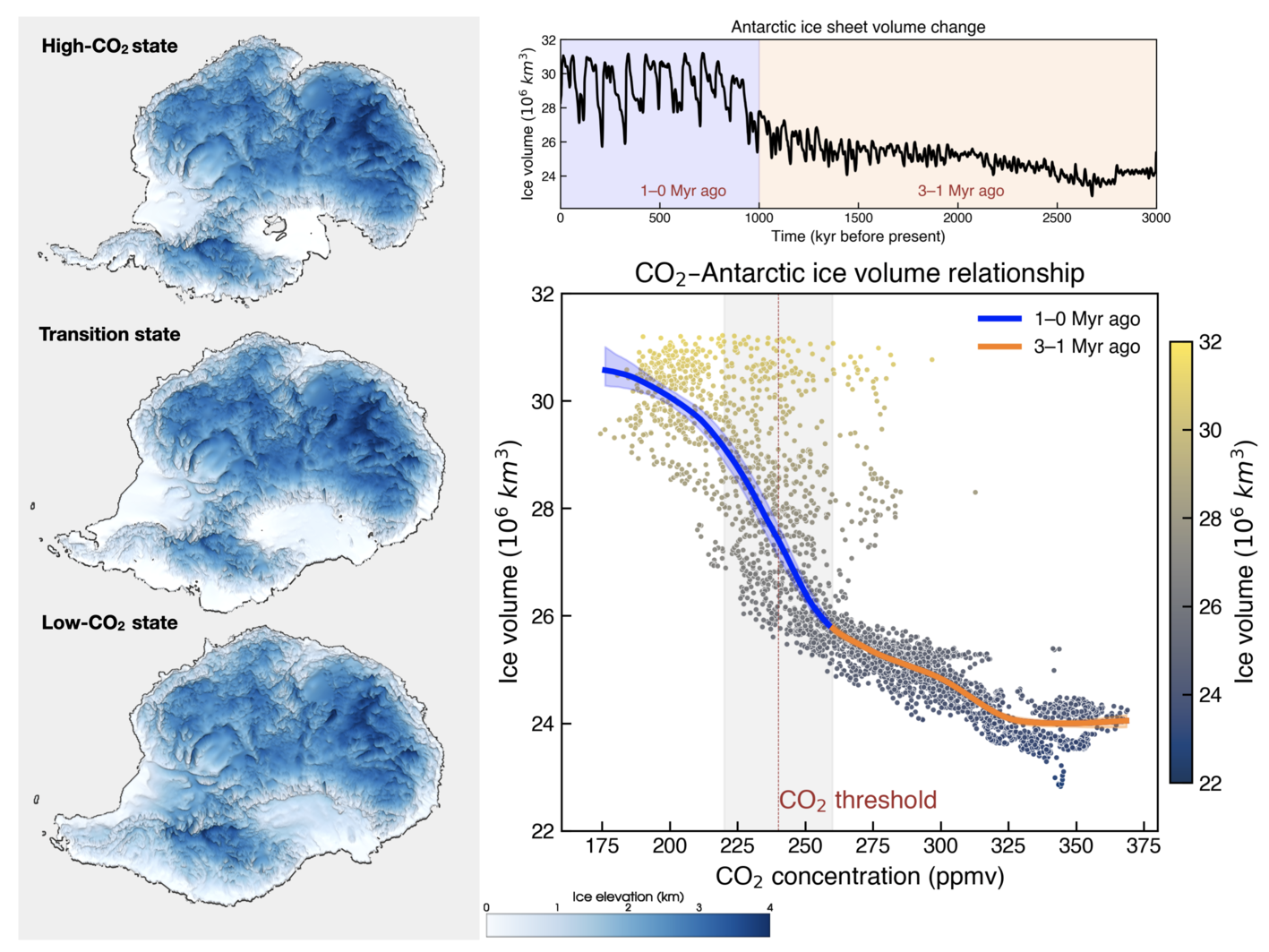 Figure 1. Relationship between atmospheric CO2 concentration and Antarctic ice volume Top right panel shows the model simulation of Antarctic ice sheet volume change covering the last 3 million years. Bottom right panel represents the relationship between atmospheric CO₂ concentration and Antarctic ice volume changes. Blue and orange lines show nonlinear fits for 1-0 million years ago and 3-1 million years ago, respectively, with shaded bands indicating the 95% uncertainty range. Maps on the left show representative Antarctic ice elevation changes under high-, transitional-, and low-CO₂ states. 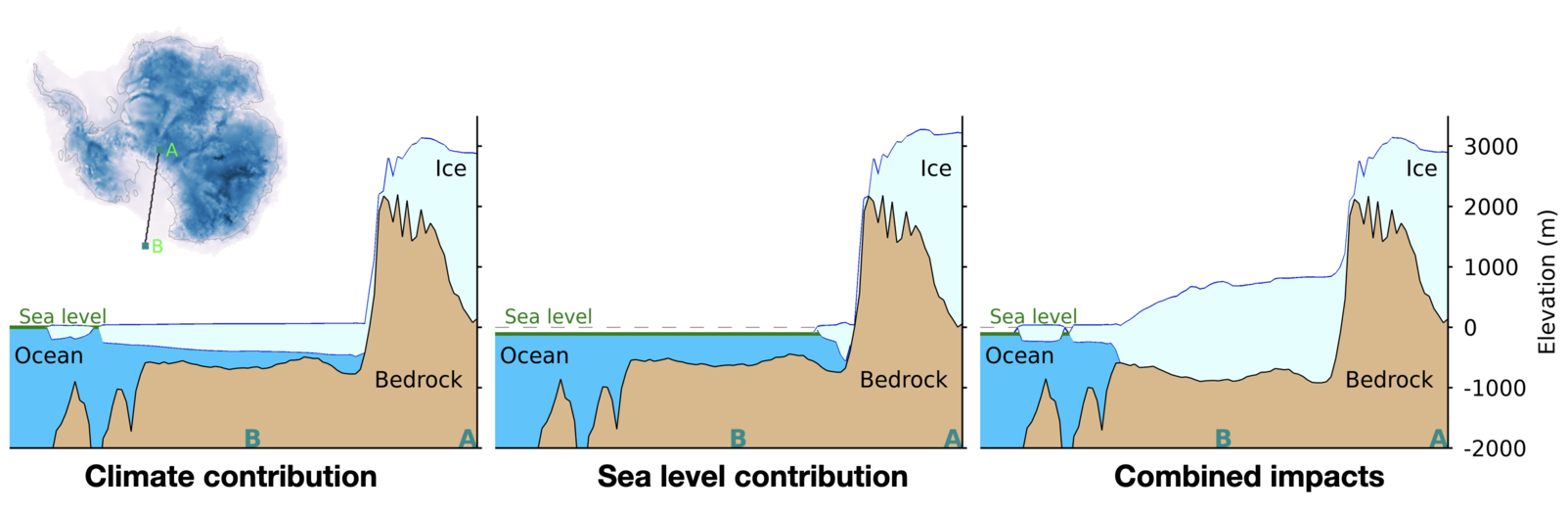 Figure 2. Antarctic ice sheet response to climate and sea level Ross Sea ice-shelf transect for low-CO₂ conditions, corresponding to high sensitivity to forcings: (left) climate contribution, (middle) sea-level contribution, and (right) combined impacts of climate and sea-level changes. Notes for editors
- References
- Media Contact
- About the Institute for Basic Science (IBS)
- About ICCP |
| before |
|---|
- Content Manager
- Public Relations Team : Suh, William Insang 042-878-8137
- Last Update 2023-11-28 14:20

55, Expo-ro, Yuseong-gu, Daejeon, Korea, 34126
Tel. +82-42-878-8114 | Fax. +82-42-878-8079 | E-mail. webmaster@ibs.re.kr
Copyright(c) IBS. All Rights Reserved.