주메뉴
- About IBS 연구원소개
-
Research Centers
연구단소개
- Research Outcomes
- Mathematics
- Physics
- Center for Underground Physics
- Center for Theoretical Physics of the Universe (Particle Theory and Cosmology Group)
- Center for Theoretical Physics of the Universe (Cosmology, Gravity and Astroparticle Physics Group)
- Dark Matter Axion Group
- Center for Artificial Low Dimensional Electronic Systems
- Center for Quantum Nanoscience
- Center for Exotic Nuclear Studies
- Center for Van der Waals Quantum Solids
- Center for Relativistic Laser Science
- Center for Trapped Ion Quantum Science
- Chemistry
- Life Sciences
- Center for Memory and Glioscience (Cognitive Glioscience Group)
- Center for Memory and Glioscience (Learning and Memory Group)
- Center for Synaptic Brain Dysfunctions
- Center for RNA Research
- Center for Genomic Integrity
- Center for Vascular Research
- Center for Genome Engineering
- Center for Microbiome–Body–Brain Physiology
- Earth Science
- Interdisciplinary
- Center for Neuroscience Imaging Research (Neuro Technology Group)
- Center for Neuroscience Imaging Research (Cognitive and Computational Neuroscience Group)
- Center for Algorithmic and Robotized Synthesis
- Center for Nanomedicine
- Center for Biomolecular and Cellular Structure
- Center for 2D Quantum Heterostructures
- Institutes
- Korea Virus Research Institute
- News Center 뉴스 센터
- Career 인재초빙
- Living in Korea IBS School-UST
- IBS School 윤리경영

주메뉴
- About IBS
-
Research Centers
- Research Outcomes
- Mathematics
- Physics
- Center for Underground Physics
- Center for Theoretical Physics of the Universe (Particle Theory and Cosmology Group)
- Center for Theoretical Physics of the Universe (Cosmology, Gravity and Astroparticle Physics Group)
- Dark Matter Axion Group
- Center for Artificial Low Dimensional Electronic Systems
- Center for Quantum Nanoscience
- Center for Exotic Nuclear Studies
- Center for Van der Waals Quantum Solids
- Center for Relativistic Laser Science
- Center for Trapped Ion Quantum Science
- Chemistry
- Life Sciences
- Center for Memory and Glioscience (Cognitive Glioscience Group)
- Center for Memory and Glioscience (Learning and Memory Group)
- Center for Synaptic Brain Dysfunctions
- Center for RNA Research
- Center for Genomic Integrity
- Center for Vascular Research
- Center for Genome Engineering
- Center for Microbiome–Body–Brain Physiology
- Earth Science
- Interdisciplinary
- Center for Neuroscience Imaging Research (Neuro Technology Group)
- Center for Neuroscience Imaging Research (Cognitive and Computational Neuroscience Group)
- Center for Algorithmic and Robotized Synthesis
- Center for Nanomedicine
- Center for Biomolecular and Cellular Structure
- Center for 2D Quantum Heterostructures
- Institutes
- Korea Virus Research Institute
- News Center
- Career
- Living in Korea
- IBS School



News Center

Can AI Really Be Conscious? Researchers Call for More Rigorous Scientific Standards- Researchers examine the methodological limits of current consciousness science across animals, AI, fetuses, and organoids - As artificial intelligence systems become increasingly sophisticated, questions once confined to philosophy are rapidly entering mainstream scientific and public debate: Can AI possess consciousness? Could animals, organoids, or even fetuses have subjective experiences? A research team led by Director Hakwan LAU of the Center for Neuroscience Imaging Research within the Institute for Basic Science (IBS), together with collaborators from the Université de Montréal and New York University, has published a new analysis arguing that current scientific methods may not yet be capable of reliably answering such questions. The paper critically examines how consciousness is currently studied in neuroscience and argues that many widely used experimental approaches fail to clearly distinguish subjective experience from general information processing. The researchers emphasize that the study does not attempt to determine whether animals, AI systems, fetuses, or organoids are conscious. Instead, it asks a more fundamental question: Are current scientific methods actually measuring consciousness itself? “Many current theories of consciousness appear to be supported by a range of experimental findings,” said Director Hakwan LAU. “But those findings may actually reflect general information processing rather than consciousness itself — so it remains difficult to conclude that these theories truly explain consciousness.” The paper argues that popular experimental paradigms — including visual masking, binocular rivalry, and perceptual threshold detection — often alter not only conscious experience, but also the brain’s overall ability to process information. As a result, researchers may unintentionally conflate consciousness with broader perceptual and cognitive capacity. The authors further caution that this methodological ambiguity may contribute to increasingly strong claims about consciousness in non-human entities. Recent years have seen growing scientific and public discussion surrounding animal consciousness, conscious AI, fetal consciousness, and laboratory-grown brain organoids, with some researchers suggesting that these entities may possess forms of subjective experience or sentience. According to the team, however, many of the experimental “markers” used to support such claims may primarily track information processing rather than conscious experience itself. The researchers note that similar problems have appeared before in the history of psychology. In the late nineteenth and early twentieth centuries, strong but poorly grounded claims about consciousness contributed to major scientific backlash, eventually leading to the rise of behaviorism and decades-long skepticism toward consciousness research. To move the field forward, the paper highlights neuropsychological conditions such as blindsight and hemispatial neglect, in which conscious awareness can become dissociated from perception and behavior. These cases suggest that subjective experience and information processing may be separable processes, offering potentially more rigorous ways to investigate consciousness scientifically. The researchers argue that developing methods capable of isolating subjective experience more precisely will be essential for evaluating future claims about consciousness in animals, AI systems, organoids, and other non-human entities. “Questions about consciousness increasingly carry ethical and societal implications,” Lau said. “If scientific claims about consciousness are going to influence discussions about animal welfare, AI ethics, or bioethics, then the scientific foundations supporting those claims must be especially rigorous.” The team hopes the study will encourage more careful methodological standards and greater conceptual clarity in the rapidly expanding field of consciousness science. The findings were published in the journal Neuron on May 26. 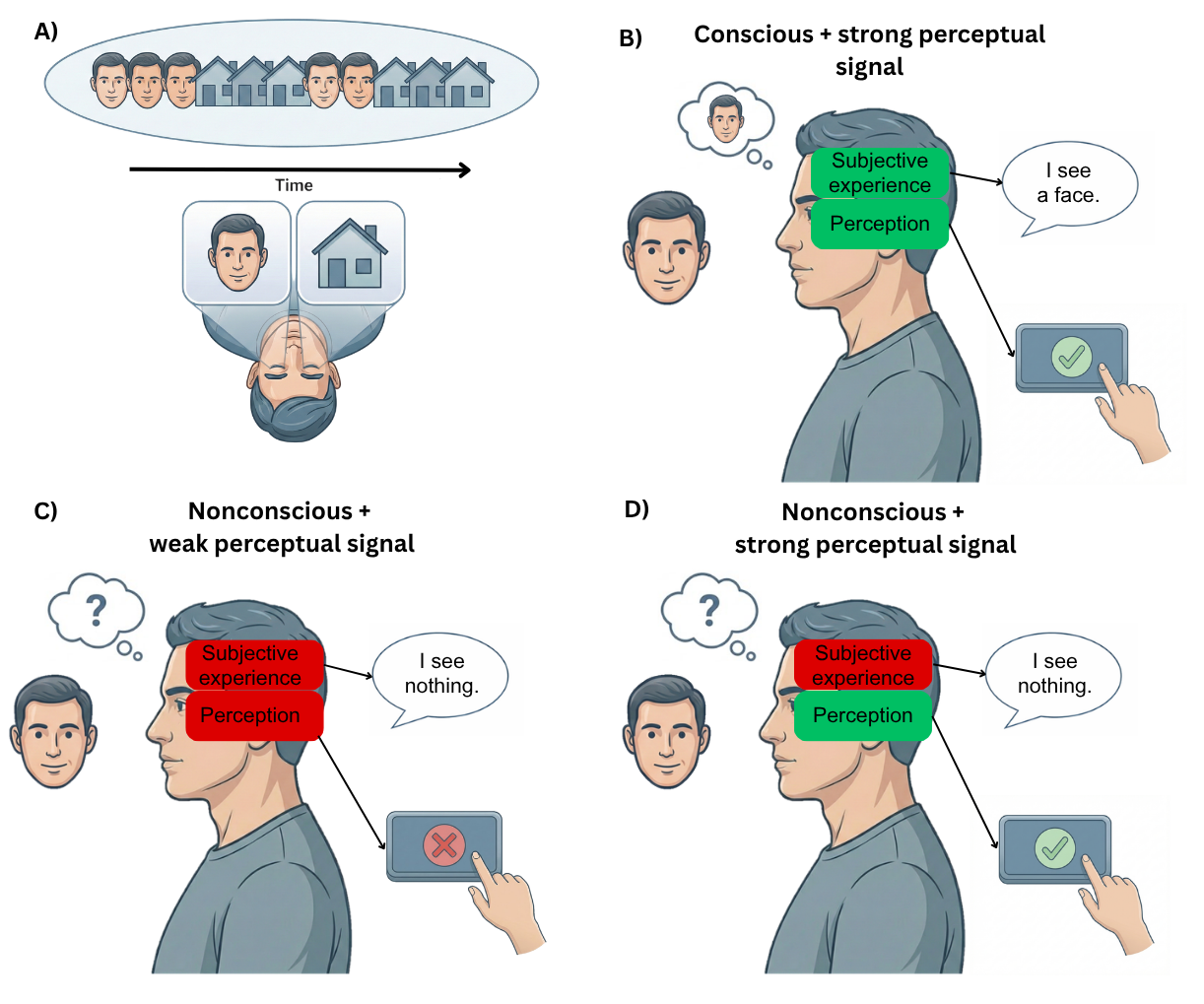 Figure 1. The conflation of perception and subjective experience in consciousness science A) Many experimental paradigms in consciousness research contrast consciously perceived stimuli with nonconscious ones as in the case of binocular rivalry, illustrated here. B) When a stimulus is consciously perceived, it can be reported as such, and it generates strong perceptual and cognitive signals in the brain (e.g., the category of the stimuli is also processed). C) However, when the experimental manipulation makes a stimulus invisible, it often doesn’t only abolish subjective experience. Rather, it also prevents the general processing of the stimulus by the brain. D) Importantly, some experimental approaches can help better control this methodological confound (see section Forgotten Lessons), by selectively abolishing the subjective experience of seeing, while leaving general perceptual processing relatively intact. Notes for editors
- References
- Media Contact
- About the Institute for Basic Science (IBS) |
| before |
|---|
- Content Manager
- Public Relations Team : Suh, William Insang 042-878-8137
- Last Update 2023-11-28 14:20
55, Expo-ro, Yuseong-gu, Daejeon, Korea, 34126
Tel. +82-42-878-8114 | Fax. +82-42-878-8079 | E-mail. webmaster@ibs.re.kr
Copyright(c) IBS. All Rights Reserved.