주메뉴
- About IBS 연구원소개
-
Research Centers
연구단소개
- Research Outcomes
- Mathematics
- Physics
- Center for Underground Physics
- Center for Theoretical Physics of the Universe (Particle Theory and Cosmology Group)
- Center for Theoretical Physics of the Universe (Cosmology, Gravity and Astroparticle Physics Group)
- Dark Matter Axion Group
- Center for Artificial Low Dimensional Electronic Systems
- Center for Quantum Nanoscience
- Center for Exotic Nuclear Studies
- Center for Van der Waals Quantum Solids
- Center for Relativistic Laser Science
- Center for Trapped Ion Quantum Science
- Chemistry
- Life Sciences
- Center for Memory and Glioscience (Cognitive Glioscience Group)
- Center for Memory and Glioscience (Learning and Memory Group)
- Center for Synaptic Brain Dysfunctions
- Center for RNA Research
- Center for Genomic Integrity
- Center for Vascular Research
- Center for Genome Engineering
- Center for Microbiome–Body–Brain Physiology
- Earth Science
- Interdisciplinary
- Center for Neuroscience Imaging Research (Neuro Technology Group)
- Center for Neuroscience Imaging Research (Cognitive and Computational Neuroscience Group)
- Center for Algorithmic and Robotized Synthesis
- Center for Nanomedicine
- Center for Biomolecular and Cellular Structure
- Center for 2D Quantum Heterostructures
- Institutes
- Korea Virus Research Institute
- News Center 뉴스 센터
- Career 인재초빙
- Living in Korea IBS School-UST
- IBS School 윤리경영

주메뉴
- About IBS
-
Research Centers
- Research Outcomes
- Mathematics
- Physics
- Center for Underground Physics
- Center for Theoretical Physics of the Universe (Particle Theory and Cosmology Group)
- Center for Theoretical Physics of the Universe (Cosmology, Gravity and Astroparticle Physics Group)
- Dark Matter Axion Group
- Center for Artificial Low Dimensional Electronic Systems
- Center for Quantum Nanoscience
- Center for Exotic Nuclear Studies
- Center for Van der Waals Quantum Solids
- Center for Relativistic Laser Science
- Center for Trapped Ion Quantum Science
- Chemistry
- Life Sciences
- Center for Memory and Glioscience (Cognitive Glioscience Group)
- Center for Memory and Glioscience (Learning and Memory Group)
- Center for Synaptic Brain Dysfunctions
- Center for RNA Research
- Center for Genomic Integrity
- Center for Vascular Research
- Center for Genome Engineering
- Center for Microbiome–Body–Brain Physiology
- Earth Science
- Interdisciplinary
- Center for Neuroscience Imaging Research (Neuro Technology Group)
- Center for Neuroscience Imaging Research (Cognitive and Computational Neuroscience Group)
- Center for Algorithmic and Robotized Synthesis
- Center for Nanomedicine
- Center for Biomolecular and Cellular Structure
- Center for 2D Quantum Heterostructures
- Institutes
- Korea Virus Research Institute
- News Center
- Career
- Living in Korea
- IBS School



News Center

Scientists Reveal How Cells “Back Up” DNA Replication to Survive Severe Damage- DNA helicase HELQ promotes replication fork reversal, protecting cells from toxic DNA crosslinks - Every time a cell divides, it must copy its DNA with extraordinary precision. But this process is constantly challenged by DNA damage. Among the most dangerous lesions are DNA interstrand crosslinks (ICLs), which chemically bind the two strands of DNA together and block the machinery responsible for copying the genome. These lesions are not only produced naturally in cells but are also deliberately induced by widely used chemotherapy drugs such as cisplatin and mitomycin C. If not properly managed, they can cause catastrophic DNA breakage and cell death. A research team led by Dr. Kei-ichi TAKATA at the Center for Genomic Integrity within the Institute for Basic Science (IBS) has uncovered how cells protect themselves from this severe form of DNA damage. Their findings reveal that the DNA helicase HELQ plays a key role in stabilizing stalled DNA replication by actively remodeling DNA structures. When DNA is being copied, it forms a Y-shaped structure known as a replication fork. If the fork encounters an obstacle such as a crosslink, it can stall abruptly. Without proper handling, this can lead to mutations, chromosome breakage, or cell death. The researchers found that HELQ enables a protective response called replication fork reversal. In this process, the replication machinery temporarily “backs up,” converting the fork into a four-way DNA structure. This stabilizes the damaged site and gives the cell time to repair the DNA safely. Using DNA fiber analysis, the team observed that normal cells slow down replication when exposed to crosslinking agents—a hallmark of fork reversal. In contrast, cells lacking HELQ failed to show this response, indicating that HELQ is required for this protective slowdown. To directly visualize these structures, the researchers used electron microscopy and confirmed that HELQ-deficient cells form significantly fewer reversed forks under replication stress. The study further shows that HELQ is not just a passive participant but an active molecular motor. Further experiments showed that HELQ acts directly at damaged replication sites, using its enzymatic activity to reshape DNA and promote fork reversal. This function depends on HELQ’s enzymatic activity—when the researchers tested a helicase-inactive mutant, cells lost the ability to properly slow replication under DNA damage, confirming that HELQ’s activity is essential. HELQ was also found to work together with the BCDX2 complex, a DNA repair complex, with both acting in the same pathway to promote fork reversal. Previous studies had shown that cells lacking HELQ are unusually sensitive to DNA crosslinking agents, but the reason was unclear. This study now provides a clear explanation: without HELQ, cells cannot properly reverse and stabilize stalled replication forks. As a result, DNA damage accumulates and becomes more toxic. The researchers also found that HELQ helps limit error-prone repair pathways. In its absence, cells rely more heavily on alternative mechanisms that can introduce mutations, highlighting HELQ’s role in maintaining genome stability. Because DNA crosslinking agents are widely used in cancer treatment, these findings have important implications for cancer biology. Differences in HELQ activity may influence how cancer cells respond to chemotherapy, potentially affecting both sensitivity and resistance to treatment. “This study explains why HELQ-deficient cells are highly sensitive to DNA crosslinking agents,” said Director MYUNG Kyungjae. “By showing that HELQ directly promotes replication fork reversal, we now have a clearer picture of how cells protect their genomes against one of the most toxic forms of DNA damage.” Overall, the study identifies HELQ as a critical regulator of replication fork remodeling. By enabling stalled replication forks to reverse and stabilize, HELQ helps cells survive severe DNA damage while minimizing mutations. These findings advance our understanding of how human cells maintain genome integrity under replication stress and provide a foundation for future studies on how cancer cells respond to DNA-damaging therapies. The study was published in Nucleic Acids Research on April 29, 2026. 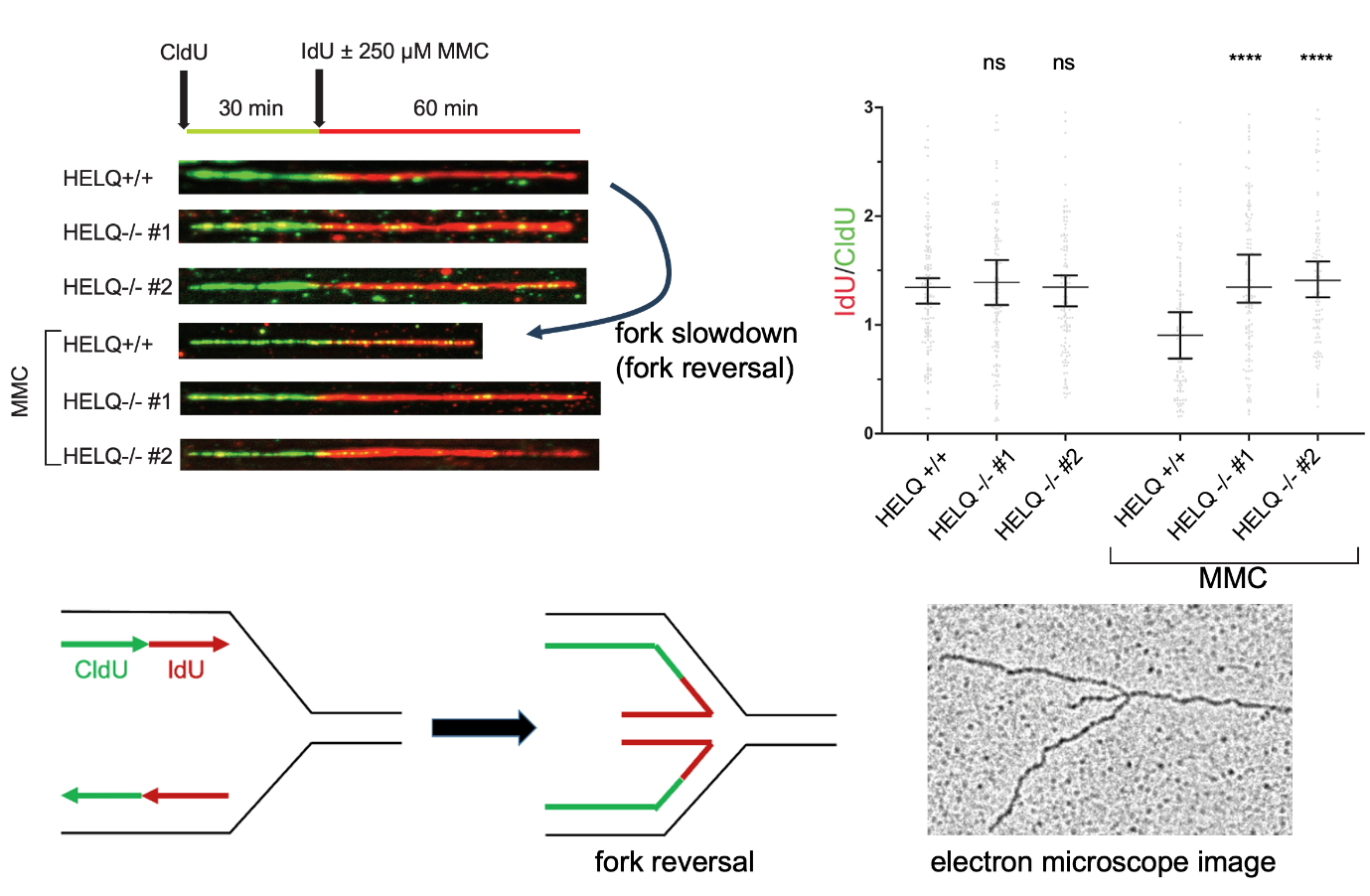 Figure 1. HELQ promotes fork slowdown (fork reversal) after treatment with a crosslinking agent A representative figure showing that HELQ-deficient cells fail to undergo normal fork slowing after MMC (a crosslinking agent) treatment, consistent with defective fork reversal. 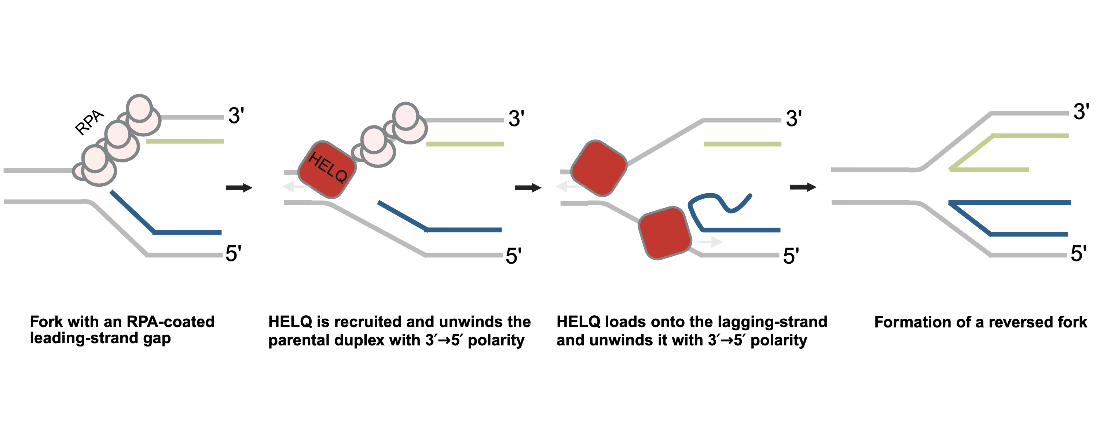 Figure 2. Working model of HELQ function A schematic model proposing that HELQ acts at an RPA-coated leading-strand gap to drive replication fork reversal and facilitate safe interstrand crosslink repair. Notes for editors
- References
- Media Contact
- About the Institute for Basic Science (IBS) |
| before |
|---|
- Content Manager
- Public Relations Team : Suh, William Insang 042-878-8137
- Last Update 2023-11-28 14:20
55, Expo-ro, Yuseong-gu, Daejeon, Korea, 34126
Tel. +82-42-878-8114 | Fax. +82-42-878-8079 | E-mail. webmaster@ibs.re.kr
Copyright(c) IBS. All Rights Reserved.