Illuminating the Universe's Mysteries with Extreme Light
Interview with KIM Kyung Taec, Director of the IBS Center for Relativistic Laser Science
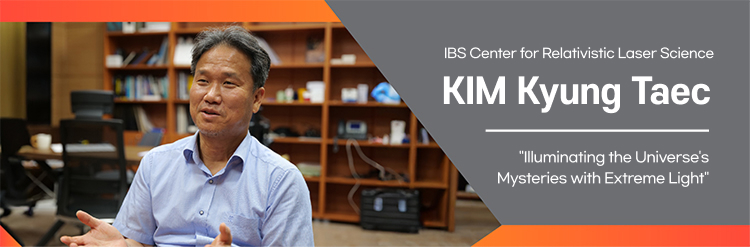
In the “City of Light,” Gwangju, the Institute for Basic Science (IBS) operates a research center at the Gwangju Institute of Science and Technology (GIST) dedicated to uncovering the universe’s mysteries using extreme laser light. This is the Center for Relativistic Laser Science. We met with Director KIM Kyung Taec, Professor of Physics and Photon Science at GIST, to discuss his ambitious scientific challenge.
A New World of Physics Opened by Extreme Lasers
“The IBS Center for Relativistic Laser Science was created to discover what happens under nature’s most extreme conditions,” Director Kim explained of the center, which launched late last year. The “extreme conditions” he refers to are not scorching heat waves or thin air at high altitudes, but the circumstances that arise when particles move at the speed of light and enter unimaginably small realms.
In such regimes, the everyday laws of physics no longer apply. As an object approaches the speed of light, time slows, and its mass increases — as dictated by Einstein’s theory of relativity. When an object becomes extremely small, it no longer behaves like a solid ball but spreads like a wave and exists probabilistically — the domain of quantum mechanics.
Director Kim emphasized that these situations require quantum electrodynamics (QED), one of physics’ most precise theoretical frameworks. “When these conditions occur, truly cataclysmic phenomena take place — almost like heaven and earth splitting open. Light transforms into electrons, and particles appear out of what seems like empty vacuum.” Such extreme environments occur naturally only in rare cosmic settings, such as near black holes. The center aims to recreate them on Earth using lasers. The field of “strong-field QED” explores QED effects that arise dramatically in powerful electromagnetic fields, such as those generated by intense laser pulses. Experimentally realizing and theoretically analyzing these effects is the center’s core objective.
Director Kim summarized the center’s research goals in three areas. First is ultra-intense laser development; creating conditions where the laws of nature behave differently requires lasers of unprecedented power. Second is the study of laser–matter interactions, particularly the reactions that occur when lasers strike plasma (ionized gas). These processes produce various particles and radiation, including X-rays, protons, and electron beams. Third is experimentation on strong-field QED phenomena. By combining the first two research areas, the center aims to explore extreme physical processes in which light transforms into matter and matter back into light.
Director Kim previously served as Associate Director of the IBS Center for Relativistic Laser Science at GIST, where he contributed to developing world-class lasers. The new Center for Relativistic Laser Science is an effort to push the frontier even further with more advanced technology and new conceptual approaches. “Building on the foundation of earlier research, we are now attempting genuine extreme QED experiments. The direction is similar, but the depth is much greater,” he noted.
Strong-Field QED Experiments with Attosecond Pulses
Director Kim received his master’s and doctoral degrees from KAIST’s Department of Physics, and then worked at GIST’s Advanced Photonics Research Institute, Canada’s National Research Council (NRC), and the University of Ottawa before joining GIST as a professor in 2014. He gained international recognition for proposing methods to overcome technological limitations using new extreme ultraviolet (XUV) attosecond (10⁻¹⁸ seconds) pulse compression techniques. His work includes high-harmonic studies on plasma mirrors using flat liquid sheets, expanding methods of XUV generation, and developing laser pulse measurement technologies based on tunneling ionization.
The 2023 Nobel Prize in Physics was awarded to researchers who pioneered the attosecond field, including the first scientist to measure attosecond pulse trains in 2001. Director Kim, then a graduate student, analyzed dispersion issues in attosecond pulses and proposed solutions for shortening them. “If you know the absorption rates by wavelength, you can understand the dispersion relationship. In the X-ray region, mirror use is limited, so pulse shaping must rely on different methods,” he explained. “Recently, I developed a new laser pulse measurement technique using tunneling ionization, and many research groups are now adopting it. It’s deeply gratifying to hear presentations from researchers I’ve never met saying they experimented using this method.”
The center observes strong-field QED phenomena by irradiating attosecond pulses onto relativistic electrons — electrons moving near the speed of light. When plasma is accelerated by a laser, strong attosecond pulses are generated as the pulse width shortens during reflection. Collision experiments are then performed by accelerating electrons inside the plasma with another laser. “When attosecond pulses strike relativistic electrons, the electrons perceive the light intensity as much stronger. This effect triggers strong-field QED phenomena,” Director Kim said.
He cited three observable strong-field QED processes: nonlinear Compton scattering, electron–positron pair production, and QED plasma generation. Nonlinear Compton scattering occurs when fast electrons absorb multiple photons from a powerful laser and emit gamma rays — a phenomenon that the previous research center successfully demonstrated, with ongoing follow-up studies. Pair production refers to the creation of electrons and positrons when gamma rays collide with a powerful laser. Repeated gamma ray emission and pair production can form a chain reaction, producing a QED plasma — a state where electrons, positrons, and gamma rays continuously appear and annihilate.
“Realizing QED plasma experimentally is our ultimate goal. Achieving this would be a scientific breakthrough of historic significance,” Director Kim said. While these phenomena occur naturally near neutron stars and black holes, they are difficult to study directly and generally require astronomical observation. “If we can create QED plasma with lasers, we can reproduce aspects of astrophysical phenomena in the laboratory. It would be a major scientific leap,” he said, referring to this concept as “laboratory astrophysics.”
Aiming to Become a World-Leading Research Center
The Center aims to use powerful attosecond pulses to study quantum mechanical phenomena, clarify extreme light–matter interactions, and contribute to advances in fields such as astrophysics, chemistry, and the life sciences. Director Kim described the center’s expected impact both short-term and long-term. “In the long term, we expand knowledge in basic science by advancing quantum mechanics and QED theory. In the short term, through laser–plasma interaction research, we can create secondary light sources such as X-rays, XUV, electrons, and protons that can be applied in industry and medicine.” XUV radiation is used in the semiconductor industry, X-rays in materials and biomedical imaging, and proton beams in proton therapy.
The center also benefits from its location at GIST. “Students’ active participation, collaboration with the Advanced Photonics Research Institute, and GIST’s support create an excellent research environment,” he noted. Since its founding, GIST has emphasized optics as a core field, and the presence of many experts at the Advanced Photonics Research Institute fosters close communication with domestic researchers.
Collaboration is active both domestically and internationally. Korea University, UNIST, the Korea Electrotechnology Research Institute, and the Korea Atomic Energy Research Institute are conducting joint projects using the center’s laser facilities. Internationally, the center collaborates with France’s Laboratoire d’Optique Appliquée (LOA) and the European Union’s Extreme Light Infrastructure (ELI), a network of large-scale laser research facilities in the Czech Republic, Hungary, and Romania operated by the European Research Infrastructure Consortium (ERIC). “Recently, ELI proposed an experiment, and we are preparing it together,” Director Kim added.
Director Kim began his research career at KAIST in Professor NAM Chang-hee’s laboratory, who previously led the Center. Wanting to understand the nature of light, he approached the optics lab, where Professor Nam’s passion for research greatly influenced him. Although challenges and failures are routine for scientists, he recalled a painful experience during his doctoral studies when a foreign research team published results first on an experiment he had spent years preparing.
His goal remains clear: to make the Center for Relativistic Laser Science the best in the world. He hopes to raise the center’s international standing within its 8–10 year mandate and achieve recognition for its accomplishments. His personal goal as a scientist is “deepening scientific understanding enough to explain complex natural phenomena with simple principles.” Smiling, he added, “Making the center a world-class facility seems achievable, but my personal scientific goal may be something I must pursue endlessly.”





 thumb.jpg