주메뉴
- About IBS 연구원소개
-
Research Centers
연구단소개
- Research Outcomes
- Mathematics
- Physics
- Center for Underground Physics
- Center for Theoretical Physics of the Universe (Particle Theory and Cosmology Group)
- Center for Theoretical Physics of the Universe (Cosmology, Gravity and Astroparticle Physics Group)
- Dark Matter Axion Group
- Center for Artificial Low Dimensional Electronic Systems
- Center for Theoretical Physics of Complex Systems
- Center for Quantum Nanoscience
- Center for Exotic Nuclear Studies
- Center for Van der Waals Quantum Solids
- Center for Relativistic Laser Science
- Chemistry
- Life Sciences
- Earth Science
- Interdisciplinary
- Center for Neuroscience Imaging Research (Neuro Technology Group)
- Center for Neuroscience Imaging Research (Cognitive and Computational Neuroscience Group)
- Center for Algorithmic and Robotized Synthesis
- Center for Nanomedicine
- Center for Biomolecular and Cellular Structure
- Center for 2D Quantum Heterostructures
- Institutes
- Korea Virus Research Institute
- News Center 뉴스 센터
- Career 인재초빙
- Living in Korea IBS School-UST
- IBS School 윤리경영

주메뉴
- About IBS
-
Research Centers
- Research Outcomes
- Mathematics
- Physics
- Center for Underground Physics
- Center for Theoretical Physics of the Universe (Particle Theory and Cosmology Group)
- Center for Theoretical Physics of the Universe (Cosmology, Gravity and Astroparticle Physics Group)
- Dark Matter Axion Group
- Center for Artificial Low Dimensional Electronic Systems
- Center for Theoretical Physics of Complex Systems
- Center for Quantum Nanoscience
- Center for Exotic Nuclear Studies
- Center for Van der Waals Quantum Solids
- Center for Relativistic Laser Science
- Chemistry
- Life Sciences
- Earth Science
- Interdisciplinary
- Center for Neuroscience Imaging Research (Neuro Technology Group)
- Center for Neuroscience Imaging Research (Cognitive and Computational Neuroscience Group)
- Center for Algorithmic and Robotized Synthesis
- Center for Nanomedicine
- Center for Biomolecular and Cellular Structure
- Center for 2D Quantum Heterostructures
- Institutes
- Korea Virus Research Institute
- News Center
- Career
- Living in Korea
- IBS School



News Center

| Title | Designing Broad-Spectrum Antivirals Through Structural Biology | ||||
|---|---|---|---|---|---|
| Name | 전체관리자 | Registration Date | 2025-08-27 | Hits | 1263 |
| att. |
 thumb.png
|
||||
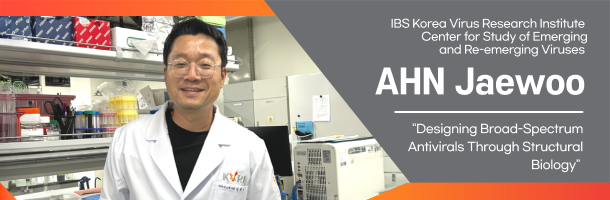
Designing Broad-Spectrum Antivirals Through Structural Biology
With concerns growing over possible resurgences of COVID-19 and the emergence of new variants, the need for antiviral strategies that go beyond the limits of existing treatments is once again in the spotlight. Against this backdrop, the Center for Study of Emerging and Re-emerging Viruses within the Korea Virus Research Institute, Institute for Basic Science (IBS) has introduced a promising therapeutic candidate that directly targets the “origin of replication” in coronaviruses. Senior Researcher AHN Jaewoo, who led the study, developed a peptide-based antiviral drug designed to block protein–protein interactions that are essential for viral self-replication, thereby preventing the formation of the viral replication enzyme complex altogether. Remarkably, in infected animal models, intranasal administration of this candidate alone achieved a 100% survival rate against otherwise lethal infections, demonstrating powerful preventive and therapeutic effects. The treatment was effective whether it was administered before or after infection, a distinction that sets it apart from many existing antivirals. Moreover, the targeted protein–protein interaction site is conserved across multiple coronaviruses, including SARS and MERS, giving the candidate both strong resistance to viral mutations and broad applicability. “This achievement is significant because it can serve as a platform strategy applicable not only to COVID-19 but also to other emerging respiratory viruses,” said Ahn. “We plan to continue refining the peptide structure for clinical use, with the goal of developing a next-generation antiviral drug that can be deployed in real-world healthcare settings.” The following is a Q&A with Senior Researcher AHN Jaewoo. Q. Please introduce yourself. Hello, my name is AHN Jaewoo, and I am a Senior Researcher at the Center for Study of Emerging and Re-emerging Viruses within the Korea Virus Research Institute, Institute for Basic Science (IBS). My specialization is in structural biology, where I investigate the three-dimensional structures of viral proteins and use this knowledge as a foundation for developing core antiviral technologies. My main focus is on precisely understanding molecular-level interactions and building the essential knowledge base required for the development of new therapeutic strategies. Q. What led you to become interested in your current field of research? Structural biology is a discipline that reveals the specificity and mechanisms of molecules at the atomic level, and I believe the essence of life phenomena lies in these molecular characteristics. Recently, Professor David BAKER’s group demonstrated the potential of using AI to predict and design protein structures, opening up new possibilities for structure-based approaches in therapeutic research. I was especially drawn to the idea that designing virus-specific proteins or peptides to precisely block key binding sites could become a next-generation antiviral strategy, and that fascination is what led me to choose this field. Q. What kind of research does the IBS Korea Virus Research Institute’s Center for Study of Emerging and Re-emerging Viruses conduct? The Center for Study of Emerging and Re-emerging Viruses was established under IBS in July 2021 to conduct basic research on viruses that newly emerge or re-emerge in the post-pandemic era. Equipped with BSL-3 facilities for studying high-risk pathogens, the center investigates the mechanisms and countermeasures for respiratory and zoonotic viruses such as influenza, SARS-CoV-2, and SFTSV. Our work spans viral replication, pathogenesis, and immune evasion, as well as structural and functional analysis and the discovery of core antiviral technologies. Through this comprehensive approach, we aim to establish a solid foundation for preparing against future pandemics. Q. What led you to pursue the strategy of blocking the formation of the replication complex itself, unlike conventional antivirals? In previous studies at our institute, we found that genetic mutations in the interface region of the SARS-CoV-2 RdRp complex altered viral activity. Building on this observation, our director proposed the idea of targeting the complex assembly process itself. I then reviewed related literature and international research cases. Indeed, reports showed that mutations at the NSP12–NSP8 binding site significantly change replication efficiency and pathogenicity, reinforcing the notion that complex formation is essential for viral replication. Based on this evidence, I became convinced that a peptide approach designed to block protein–protein interactions would be effective and distinct from conventional small-molecule inhibitors, and this is how the project began. Q. During the process of designing the peptide candidate based on cryo-EM structural analysis, what aspects did you pay particular attention to? Peptides generally lack a complete three-dimensional structure, which makes them unstable and prone to rapid degradation in the body. To overcome this limitation, we applied a cyclization design that closely mimics the binding conformation of the target site while increasing stability. We also fused the sequence of the HIV TAT peptide to ensure cell membrane permeability, thereby improving accessibility to the target protein. The key was to design the peptide sequence so that it included the critical residues of the binding hotspot identified through cryo-EM analysis. Q. Were there any difficulties during the experiments, and how did you overcome them While the TAT peptide improved cell permeability, it also made it challenging to quantitatively measure binding affinity with the target protein. In addition, the inherent instability and degradation of the peptide posed obstacles that had to be addressed. To overcome these issues, we combined different experimental conditions, such as using mild surfactants to preserve binding characteristics and immobilizing the peptides to enhance stability. Through these strategies, we were able to achieve reproducible results in assays such as MST (microscale thermophoresis) and SPR (surface plasmon resonance). Q. What are the main differences between the peptide developed in this study and existing antiviral treatments? The peptide we developed stands out from existing antivirals in several key ways. First, it can be administered intranasally, unlike most current antiviral drugs that require injection. Being peptide-based, it has high target specificity and a lower likelihood of side effects. It is also relatively simple to synthesize, making it cost-effective and suitable for large-scale production. Most small-molecule drugs typically target the catalytic sites of enzymes, whereas our peptide directly blocks the protein–protein interaction interface of the viral replication complex — a novel mechanism of action that distinguishes it from conventional therapies. Q. What does the fact that the peptide was effective both before and after infection mean for therapeutic development? Our peptide showed clear efficacy not only when administered prophylactically before infection but also when given after infection. This suggests that in emergency situations, rapid administration immediately after exposure or in the early symptomatic phase could still provide sufficient antiviral protection. The intranasal delivery method further adds convenience and speed, making it a valuable advantage for frontline responses during respiratory virus pandemics such as COVID-19. The dual preventive and therapeutic efficacy significantly broadens the potential scope of its application. Q. How likely is it that this research outcome could be applied to treating respiratory viruses beyond COVID-19? Coronaviruses, including SARS-CoV-2, share a highly conserved RdRp complex structure. The NSP12–NSP8 binding site targeted in this study is similarly present in other coronaviruses such as MERS-CoV and SARS-CoV. This means that the same design principle could be extended to develop a pan-coronavirus therapeutic. Such a platform technology could enable rapid responses to future variants or newly emerging coronaviruses. Q. Please share your plans for the next stage of this research. We are currently designing small protein sequences that can more stably recognize the binding site while enhancing structural stability. By fine-tuning their size and shape, our goal is to increase binding affinity and persistence in the body, while also establishing a general design principle applicable to a broad range of viral targets. At the same time, we are working on structural optimization to improve drug delivery and metabolic stability. Q. What are your long-term goals as a researcher? I believe that research should ultimately serve people. Even if the scale or marketability is not large, I want to contribute to providing scientific solutions to viral diseases that threaten human health. Based on structural understanding, my aim is to lay the foundation for response strategies that can be rapidly applied when needed, and through this, to play a meaningful role in responding to future infectious disease crises. |
|||||
| Next | |
|---|---|
| before |
- Content Manager
- Public Relations Team : Yim Ji Yeob 042-878-8173
- Last Update 2023-11-28 14:20
55, Expo-ro, Yuseong-gu, Daejeon, Korea, 34126
Tel. +82-42-878-8114 | Fax. +82-42-878-8079 | E-mail. webmaster@ibs.re.kr
Copyright(c) IBS. All Rights Reserved.