주메뉴
- About IBS 연구원소개
-
Research Centers
연구단소개
- Research Outcomes
- Mathematics
- Physics
- Center for Underground Physics
- Center for Theoretical Physics of the Universe (Particle Theory and Cosmology Group)
- Center for Theoretical Physics of the Universe (Cosmology, Gravity and Astroparticle Physics Group)
- Dark Matter Axion Group
- Center for Artificial Low Dimensional Electronic Systems
- Center for Theoretical Physics of Complex Systems
- Center for Quantum Nanoscience
- Center for Exotic Nuclear Studies
- Center for Van der Waals Quantum Solids
- Center for Relativistic Laser Science
- Chemistry
- Life Sciences
- Earth Science
- Interdisciplinary
- Center for Neuroscience Imaging Research (Neuro Technology Group)
- Center for Neuroscience Imaging Research (Cognitive and Computational Neuroscience Group)
- Center for Algorithmic and Robotized Synthesis
- Center for Genome Engineering
- Center for Nanomedicine
- Center for Biomolecular and Cellular Structure
- Center for 2D Quantum Heterostructures
- Institutes
- Korea Virus Research Institute
- News Center 뉴스 센터
- Career 인재초빙
- Living in Korea IBS School-UST
- IBS School 윤리경영

주메뉴
- About IBS
-
Research Centers
- Research Outcomes
- Mathematics
- Physics
- Center for Underground Physics
- Center for Theoretical Physics of the Universe (Particle Theory and Cosmology Group)
- Center for Theoretical Physics of the Universe (Cosmology, Gravity and Astroparticle Physics Group)
- Dark Matter Axion Group
- Center for Artificial Low Dimensional Electronic Systems
- Center for Theoretical Physics of Complex Systems
- Center for Quantum Nanoscience
- Center for Exotic Nuclear Studies
- Center for Van der Waals Quantum Solids
- Center for Relativistic Laser Science
- Chemistry
- Life Sciences
- Earth Science
- Interdisciplinary
- Center for Neuroscience Imaging Research (Neuro Technology Group)
- Center for Neuroscience Imaging Research (Cognitive and Computational Neuroscience Group)
- Center for Algorithmic and Robotized Synthesis
- Center for Genome Engineering
- Center for Nanomedicine
- Center for Biomolecular and Cellular Structure
- Center for 2D Quantum Heterostructures
- Institutes
- Korea Virus Research Institute
- News Center
- Career
- Living in Korea
- IBS School



News Center

| Title | Challenging Brain Disorders Through Astrocyte Exploration | ||||
|---|---|---|---|---|---|
| Name | 전체관리자 | Registration Date | 2025-11-27 | Hits | 109 |
| att. |
 thumb.jpg
|
||||
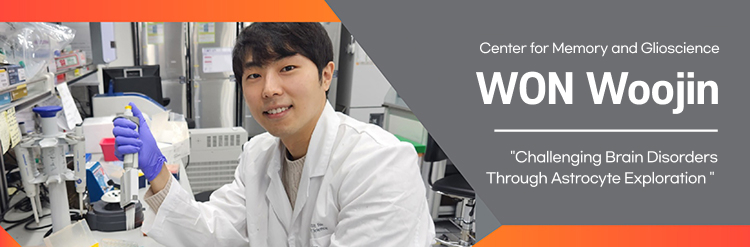
Challenging Brain Disorders Through Astrocyte Exploration
Dr. WON Woojin is a senior research fellow at the IBS Center for Memory and Glioscience, where he focuses on uncovering the fundamental mechanisms of brain disorders. His work spans neuroscience, neuronal function, and — most notably — the role of astrocytes, a major class of non-neuronal glial cells. By investigating how astrocytes contribute to the onset and progression of neurological diseases, he aims to develop new therapeutic strategies and candidate drugs grounded in basic science. His main research areas include neuron–astrocyte interactions and a wide range of brain disorders. Recently, he identified the pathological link behind post-traumatic stress disorder (PTSD) and proposed potential treatment strategies based on the underlying biological mechanisms. Dr. Won’s ultimate goal is to pinpoint the root causes of brain diseases at the cellular and molecular levels and, from this knowledge, suggest precision-medicine approaches. He is widely regarded as a rising scientist who will open new pathways for future brain therapeutics and drug development. Despite a demanding schedule filled with research and childcare, Dr. Won’s commitment and depth of thought are unmistakable — even through online interviews. “PTSD is like a fear-driven ‘blanket-kick’ you cannot escape” Q. People joke about doing a “blanket kick” when remembering something embarrassing. Is PTSD similar to that? PTSD is nothing like the light, fleeting embarrassment behind a “blanket kick.” At most, they are similar in that memories can suddenly resurface. But PTSD is a completely different experience: it is a fear memory linked to life-threatening events, capable of resurfacing at any moment — 24 hours a day, 365 days a year. In that sense, PTSD is like a relentless, involuntary “fear blanket-kick.” People often say, “Time heals all wounds,” but that simply does not apply to PTSD. When exposed to similar stimuli, the fear memory is triggered again. As the saying goes, “A burnt child dreads the fire.” A soldier might hear celebratory fireworks yet be reminded of battlefield explosions. Q. There have been many tragic incidents lately. Is there a difference between individual PTSD and collective PTSD? It is heartbreaking to hear news of such tragedies. Whether individual or collective, PTSD shares the same core mechanism: a life-threatening traumatic memory becomes imprinted in the brain and resurfaces repeatedly, disrupting one’s entire life. One difference is that collective PTSD occurs within a community that shares the same trauma. The presence of communal support and public attention can aid recovery. However, if a tragedy also destroys people’s sense of social trust and safety, it can leave behind deeper feelings of helplessness and mistrust. Inspired by “Men in Black” to explore the brain Q. When did you first become interested in the brain? I think it began with curiosity about memory and emotion. When I was young, the movie Men in Black showed a device that could erase memories with a flash of light. I was fascinated — how could someone erase only certain memories? Looking back, if such a device existed, perhaps it could erase the traumatic memories behind PTSD. Later, seeing family and acquaintances suffer from Alzheimer’s and Parkinson’s disease led me to pursue brain science more seriously. Q. How much do we currently know about the brain? In truth, we know very little. Like the universe, the brain remains overwhelmingly mysterious. In research, just when you think you understand something, another puzzle opens up — much like a Matryoshka doll with hidden layers inside. Difficult, yes, but that’s also what makes neuroscience exciting. Q. Your research often mentions astrocytes and GABA, is this connected to your earlier work on rheumatoid arthritis? Yes. This study builds on our previous research on “astrocyte changes and brain inflammation during rheumatoid arthritis.” Astrocytes are non-neuronal cells, yet they outnumber neurons and play critical roles in maintaining balance across neural circuits. Earlier, we found that inflammation caused astrocytes in the hippocampus to become dysfunctional, affecting cognition. In the new study, we found that extreme stress or trauma causes astrocytes in the prefrontal cortex to become pathologically transformed, producing excessive GABA. The key point is that astrocytes respond not only to inflammation but also to psychological stress — disrupting the brain’s functional balance. Q. What exactly is GABA, and how does it block fear-memory extinction? GABA is a major neurotransmitter that suppresses neuronal activity — essentially the brain’s “brake.” Glutamate acts as the “accelerator,” exciting neurons. GABA acts as the “brake,” inhibiting them. In PTSD, pathologically altered astrocytes release too much GABA. This excessively suppresses the neurons responsible for extinguishing fear memories. As a result, the “fear extinction circuit” fails to operate, and the traumatic memory continues to resurface. Q. Could this lead to broader treatments related to memory? Yes. Our center begins with the question: “What if memory isn’t stored exclusively in neurons?” Evidence increasingly suggests that astrocytes may play essential roles in memory formation and maintenance. “Neuroscientists are hot” Q. AI is in the spotlight these days, won’t neuroscience be the next big field? I think neuroscience is already hot. It’s half a joke, but AI itself is built from ideas inspired by brain function. If we incorporate regulatory principles not only from neurons but also from non-neuronal cells like astrocytes, AI algorithms might evolve even further. As AI grows, I hope neuroscience grows in synergy. Q. You seem close to Director C Justin LEE. Does he push you hard? Director Lee (my PhD advisor) is like a parent to me. Rather than pushing me just to produce results, he guided me to “become a good scientist.” Research involves many failures, but the satisfaction of uncovering a principle makes the effort worthwhile. Q. What do you do outside of research? Sometimes I message Director Lee to discuss research after work. Otherwise, I try to catch up on sleep. Recently, with my new baby, I’ve been focusing on childcare — witnessing the miracle of life growing day by day. “Biomedical science is like a bouncing ball—frustrating, unpredictable, but full of breakthroughs” Q. Any advice for young students or peers pursuing biomedical research? Biomedical science is like a bouncing rubber ball. It’s unpredictable; you constantly hit walls. But that bounce — the rebound — often leads to new discoveries. And someday, that discovery may change someone’s life. That belief is what makes us keep bouncing back up. |
|||||
| before |
|---|
- Content Manager
- Public Relations Team : Yim Ji Yeob 042-878-8173
- Last Update 2023-11-28 14:20
55, Expo-ro, Yuseong-gu, Daejeon, Korea, 34126
Tel. +82-42-878-8114 | Fax. +82-42-878-8079 | E-mail. webmaster@ibs.re.kr
Copyright(c) IBS. All Rights Reserved.