주메뉴
- About IBS 연구원소개
-
Research Centers
연구단소개
- Research Outcomes
- Mathematics
- Physics
- Center for Underground Physics
- Center for Theoretical Physics of the Universe (Particle Theory and Cosmology Group)
- Center for Theoretical Physics of the Universe (Cosmology, Gravity and Astroparticle Physics Group)
- Dark Matter Axion Group
- Center for Artificial Low Dimensional Electronic Systems
- Center for Theoretical Physics of Complex Systems
- Center for Quantum Nanoscience
- Center for Exotic Nuclear Studies
- Center for Van der Waals Quantum Solids
- Center for Relativistic Laser Science
- Chemistry
- Life Sciences
- Earth Science
- Interdisciplinary
- Center for Neuroscience Imaging Research (Neuro Technology Group)
- Center for Neuroscience Imaging Research (Cognitive and Computational Neuroscience Group)
- Center for Algorithmic and Robotized Synthesis
- Center for Genome Engineering
- Center for Nanomedicine
- Center for Biomolecular and Cellular Structure
- Center for 2D Quantum Heterostructures
- Institutes
- Korea Virus Research Institute
- News Center 뉴스 센터
- Career 인재초빙
- Living in Korea IBS School-UST
- IBS School 윤리경영

주메뉴
- About IBS
-
Research Centers
- Research Outcomes
- Mathematics
- Physics
- Center for Underground Physics
- Center for Theoretical Physics of the Universe (Particle Theory and Cosmology Group)
- Center for Theoretical Physics of the Universe (Cosmology, Gravity and Astroparticle Physics Group)
- Dark Matter Axion Group
- Center for Artificial Low Dimensional Electronic Systems
- Center for Theoretical Physics of Complex Systems
- Center for Quantum Nanoscience
- Center for Exotic Nuclear Studies
- Center for Van der Waals Quantum Solids
- Center for Relativistic Laser Science
- Chemistry
- Life Sciences
- Earth Science
- Interdisciplinary
- Center for Neuroscience Imaging Research (Neuro Technology Group)
- Center for Neuroscience Imaging Research (Cognitive and Computational Neuroscience Group)
- Center for Algorithmic and Robotized Synthesis
- Center for Genome Engineering
- Center for Nanomedicine
- Center for Biomolecular and Cellular Structure
- Center for 2D Quantum Heterostructures
- Institutes
- Korea Virus Research Institute
- News Center
- Career
- Living in Korea
- IBS School



News Center

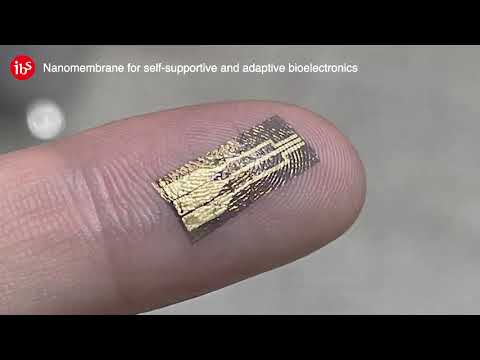
New Bioelectronics Device Based on Hydrogel- Elastomer Conductive Nanomembranes- Transformable and Imperceptible Nanomembranes Enable Seamless Integration of Electronics with Living Tissue - A research team at the Center for Neuroscience Imaging Research (CNIR) within the Institute for Basic Science (IBS), together with Sungkyunkwan University (SKKU), has developed a new class of ultra-thin, flexible bioelectronic material that can seamlessly interface with living tissues. The researchers introduced a novel device called THIN (Transformable and Imperceptible Hydrogel-Elastomer Ionic-Electronic Nanomembrane). THIN is a membrane just 350 nanometers thick that transforms from a dry, rigid film into an ultra-soft, tissue-like interface upon hydration. Biological tissues – especially vital organs such as the heart, brain, and muscles – are soft, curved, and constantly in motion. Even the thinnest existing bioelectronic devices can feel foreign, leading to poor adhesion, inflammation, and unstable signal acquisition. While ultrathin flexible devices have been developed, most still require adhesives, rigid packaging, or mechanical supports, particularly for dynamic tissues such as the heart or brain. This challenge inspired the team to ask a simple but compelling question: “What if a device could become soft, sticky, and shape-adapting only when it touches tissue – like magic?” That question led to the development of THIN, a transformable, substrate-free nanomembrane that self-adheres to wet tissue without sutures, adhesives, or external pressure. By exploiting hydration-triggered swelling, THIN self-adheres without sutures or external pressure even on microscopically folded or highly curved surfaces, which allows it to maintain long-term contact with the tissue. The nanomembrane is specifically engineered by design to be “soft when wet” and “robust when dry”. THIN consists of two layers – the first being a mussel-inspired, tissue-adhesive hydrogel (catechol-conjugated alginate; Alg-CA), and the second being a high-performance semiconducting elastomer, P(g2T2-Se). Together they form a freestanding bilayer only 350 nm thick – nearly a thousand times thinner than a human hair. The device’s bending stiffness decreases over a million-fold (to 9.08 × 10⁻⁵ GPa·μm⁴) when hydrated, allowing it to wrap around surfaces with curvature radii below 5 μm – so soft that it becomes mechanically imperceptible to tissue. When dry, the hydrogel layer is rigid (1.35 GPa), enabling easy handling and direct semiconductor coating. Upon hydration, it softens dramatically (0.035 GPa) and curls spontaneously, forming natural, gentle adhesion to the target organ surface. The selenophene-based polymer P(g2T2-Se) achieves a record µC* (mobility × capacitance product) of 1,034 F·cm⁻¹·V⁻¹·s⁻¹, roughly 3.7 times higher than conventional stretchable materials. This high ionic-electronic coupling enables organic electrochemical transistors (OECTs) built on THIN to amplify biological signals with remarkable stability even during stretching or motion. In animal experiments, THIN-OECTs instantly adhered to rodent hearts, muscles, and brain cortices, recording epicardial electrograms (EGM), electromyograms (EMG), and electrocorticograms (ECoG) with high fidelity. The devices remained stable and biocompatible for over four weeks, showing no inflammation or tissue damage after long-term implantation. “Our THIN-OECT platform acts like a nano-skin – it is invisible to the body, mechanically imperceptible, and yet electrically powerful,” said Prof. SON Donghee, corresponding author of the study. “It opens new possibilities for chronic brain-machine interfaces, cardiac monitoring, and soft neuroprosthetics.” Unlike conventional bioelectronic systems that depend on elastomeric substrates or adhesives, THIN is substrate-free, freestanding, and operational at the nanoscale. Its mechanical imperceptibility and autonomous adhesion make it suitable for stable signal acquisition from dynamic tissues without interference or foreign-body sensation. Because THIN amplifies electrophysiological signals directly at the contact site, it eliminates bulky external amplifiers, paving the way for next-generation implantable, wearable, and injectable medical devices. “By combining transformability, self-adhesion, and record-high ionic-electronic performance, THIN sets a new standard for bioelectronics that truly belong inside the body,” Prof. Son added. Future work will focus on multichannel, wireless-capable THIN arrays for closed-loop neuroprosthetics, brain-machine interfaces, and rehabilitation robotics, as well as injectable or bioresorbable versions for minimally invasive clinical use. The findings of this research have been published in Nature Nanotechnology.
Notes for editors
- References
- Media Contact
- About the Institute for Basic Science (IBS) |


| before |
|---|
- Content Manager
- Public Relations Team : Yim Ji Yeob 042-878-8173
- Last Update 2023-11-28 14:20
55, Expo-ro, Yuseong-gu, Daejeon, Korea, 34126
Tel. +82-42-878-8114 | Fax. +82-42-878-8079 | E-mail. webmaster@ibs.re.kr
Copyright(c) IBS. All Rights Reserved.