주메뉴
- About IBS 연구원소개
-
Research Centers
연구단소개
- Research Outcomes
- Mathematics
- Physics
- Center for Underground Physics
- Center for Theoretical Physics of the Universe (Particle Theory and Cosmology Group)
- Center for Theoretical Physics of the Universe (Cosmology, Gravity and Astroparticle Physics Group)
- Dark Matter Axion Group
- Center for Artificial Low Dimensional Electronic Systems
- Center for Quantum Nanoscience
- Center for Exotic Nuclear Studies
- Center for Van der Waals Quantum Solids
- Center for Relativistic Laser Science
- Chemistry
- Life Sciences
- Earth Science
- Interdisciplinary
- Center for Neuroscience Imaging Research (Neuro Technology Group)
- Center for Neuroscience Imaging Research (Cognitive and Computational Neuroscience Group)
- Center for Algorithmic and Robotized Synthesis
- Center for Nanomedicine
- Center for Biomolecular and Cellular Structure
- Center for 2D Quantum Heterostructures
- Institutes
- Korea Virus Research Institute
- News Center 뉴스 센터
- Career 인재초빙
- Living in Korea IBS School-UST
- IBS School 윤리경영

주메뉴
- About IBS
-
Research Centers
- Research Outcomes
- Mathematics
- Physics
- Center for Underground Physics
- Center for Theoretical Physics of the Universe (Particle Theory and Cosmology Group)
- Center for Theoretical Physics of the Universe (Cosmology, Gravity and Astroparticle Physics Group)
- Dark Matter Axion Group
- Center for Artificial Low Dimensional Electronic Systems
- Center for Quantum Nanoscience
- Center for Exotic Nuclear Studies
- Center for Van der Waals Quantum Solids
- Center for Relativistic Laser Science
- Chemistry
- Life Sciences
- Earth Science
- Interdisciplinary
- Center for Neuroscience Imaging Research (Neuro Technology Group)
- Center for Neuroscience Imaging Research (Cognitive and Computational Neuroscience Group)
- Center for Algorithmic and Robotized Synthesis
- Center for Nanomedicine
- Center for Biomolecular and Cellular Structure
- Center for 2D Quantum Heterostructures
- Institutes
- Korea Virus Research Institute
- News Center
- Career
- Living in Korea
- IBS School



News Center

| Title | IBS Holds 2026 New Year’s Ceremony | ||||
|---|---|---|---|---|---|
| Name | 전체관리자 | Registration Date | 2026-01-05 | Hits | 550 |
| att. |
 thumb.png
|
||||
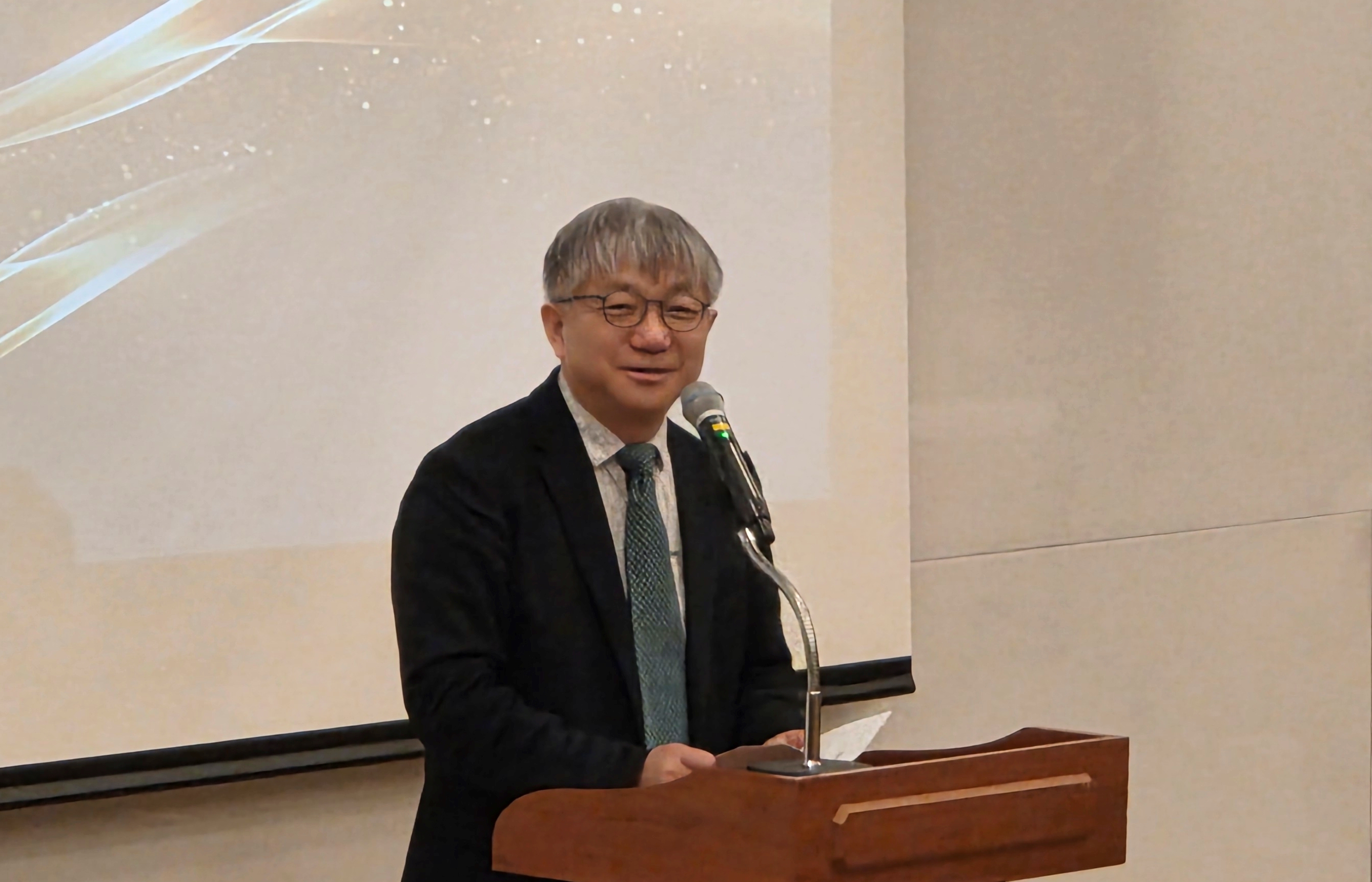
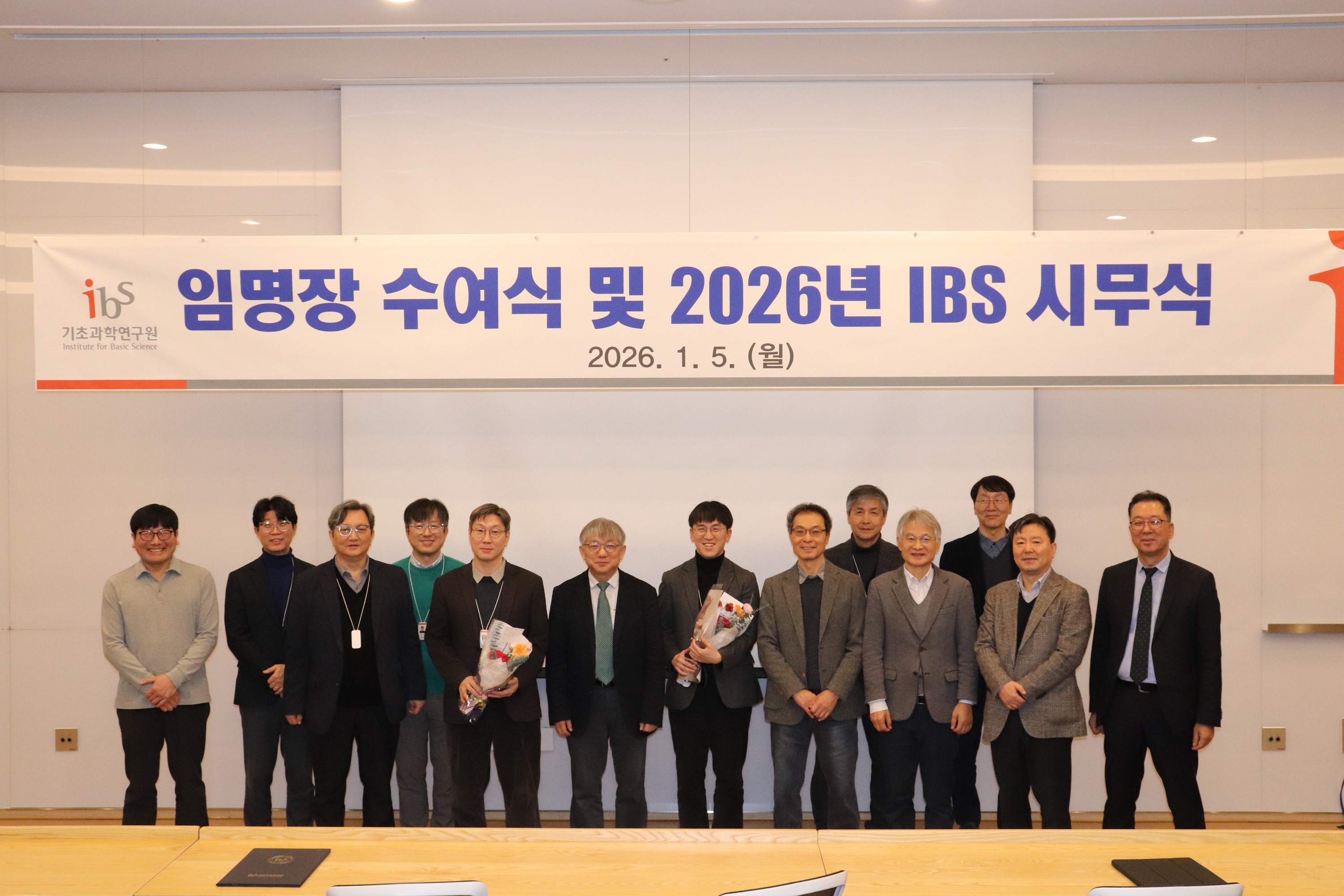
IBS Holds 2026 New Year’s Ceremony- 2026: A Year of Transition and Advancement - The Institute for Basic Science (IBS) held its 2026 New Year’s Ceremony on January 5 (Monday) at the IBS headquarters in Daejeon. At the event, Acting President KIM Yeongduk (Director of the Center for Underground Physics) delivered a New Year’s address, reflecting on the achievements of the past year and presenting key priorities for IBS in 2026 as it enters a period of transition.
Despite challenging circumstances, IBS consolidated its standing as a leading basic science research institution in 2025 by producing world-class research outcomes in major fields such as life sciences, astronomy / particle physics, and climate / environmental science. In particular, IBS researchers proposed new scientific explanations in the study of intractable diseases and infectious diseases, and continued to address fundamental questions facing humanity through research on dark matter and climate simulations. The year 2025 also marked a significant strengthening of IBS’s international profile. IBS established the “Max Planck–Yonsei IBS Center” in collaboration with the Max Planck Society of Germany and launched a “Global Partner Lab” at the University of Cambridge in the United Kingdom, securing key hubs for cooperation with leading international research institutions. At the same time, IBS researchers distinguished themselves on the global academic stage, expanding IBS’s influence within international research networks. Acting President Kim stated, “These achievements are the result of not only the passion of our researchers, but also the dedication of all IBS members who design experiments, refine data, maintain equipment, and support administration behind the scenes,” expressing his gratitude to the entire organization.
Building on this accumulated research capacity and operational experience, IBS will make 2026 a turning point for a new leap forward by pursuing three key priorities. First, IBS will further strengthen the recruitment and development of outstanding global talent. Since its founding, IBS has attracted leading scholars and promising researchers by providing a research environment that guarantees excellence and autonomy. In 2026, IBS will build on this approach by launching new research centers and Chief Investigator (CI) positions, further solidifying a globally competitive research talent ecosystem. Second, IBS will enhance the research institute system to increase the synergy of collaborative research. Moving beyond independent research at the individual center level, IBS has established a cluster-based research framework in which centers in related fields cooperate organically. In particular, IBS will promote collaboration among centers within the newly established Quantum Information Science Institute at the headquarters, leading national strategic research in quantum science and supporting the realization of convergent and high-risk, high-reward research outcomes. Third, IBS will connect its expanded research infrastructure to strengthened research competitiveness. IBS plans to ensure the stable operation of advanced research facilities and researcher housing established through the second phase of the headquarters construction project, and to provide seamless support for the relocation of the Korea Virus Basic Research Institute and the establishment of research environments for the Center for Trapped Ion Quantum Science. In addition, IBS will move forward with the construction of an IBS research building at UNIST to expand region-based research infrastructure, and will develop systematic operational strategies so that facility management and maintenance directly contribute to improved research productivity. Referring to the current transitional period during which the appointment of a new IBS president is underway, Acting President Kim stated, “I will do my utmost to ensure stable continuity in both research and administration so that there is no leadership vacuum.” He added, “If we navigate this transition without disruption, IBS will be able to begin its next phase of growth with much greater momentum under new leadership,” and called for the cooperation of all members.
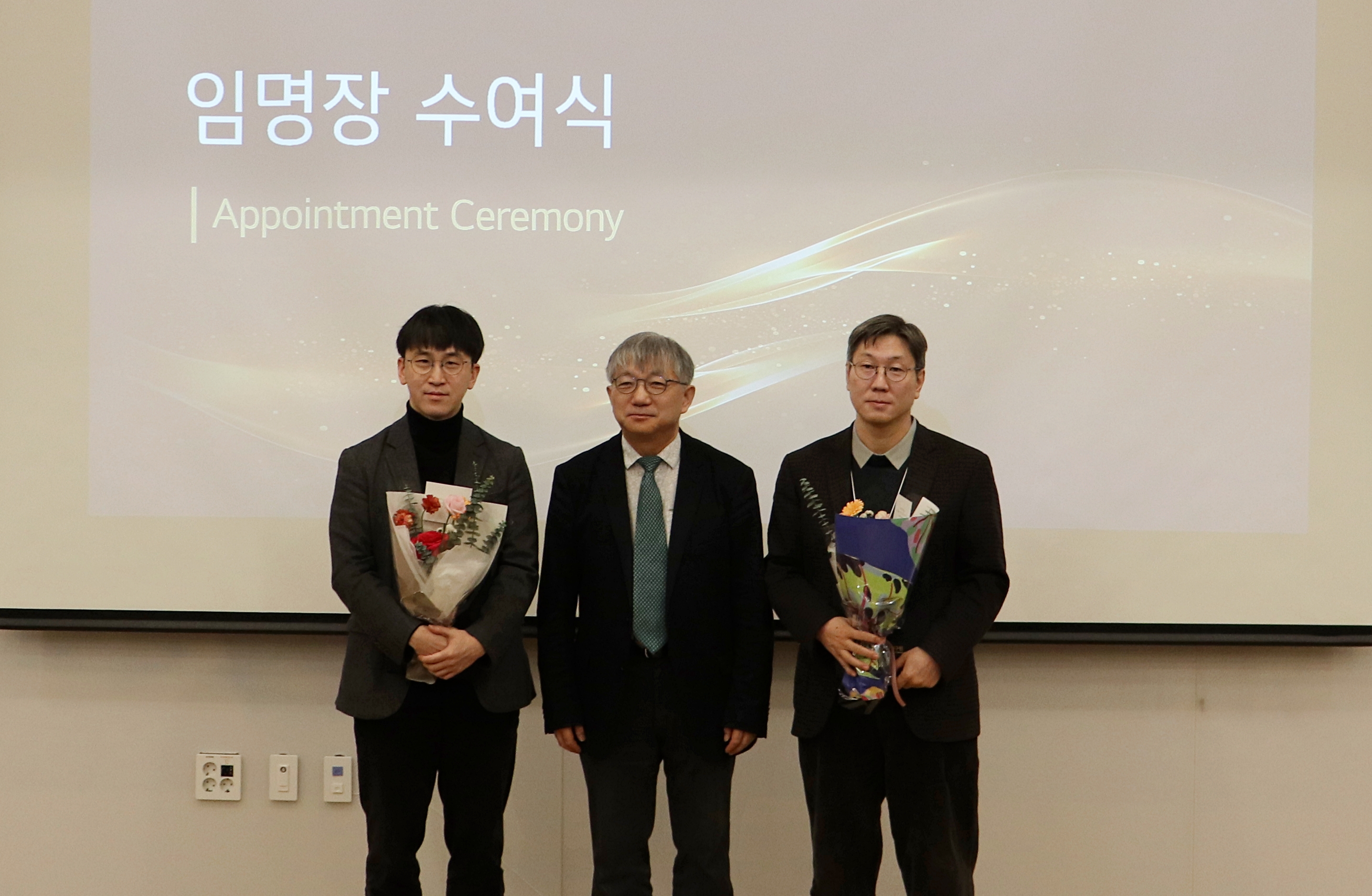
Prior to the ceremony, an appointment ceremony was held for Director KIM Kihwan of the newly launched Center for Trapped Ion Quantum Science and CI PARK Jong-Eun of the Systems Virology and Spatial Immunomics Group at the Center for Virome and Applied Platform within the Korea Virus Research Institute. Both leaders shared their reflections on taking charge of newly established research organizations and expressed their determination to pursue bold and challenging research within the IBS research environment. IBS Public Relations Team |
|||||
| before | |
|---|---|
| before |
- Content Manager
- Public Relations Team : Yim Ji Yeob 042-878-8173
- Last Update 2023-11-28 14:20
55, Expo-ro, Yuseong-gu, Daejeon, Korea, 34126
Tel. +82-42-878-8114 | Fax. +82-42-878-8079 | E-mail. webmaster@ibs.re.kr
Copyright(c) IBS. All Rights Reserved.