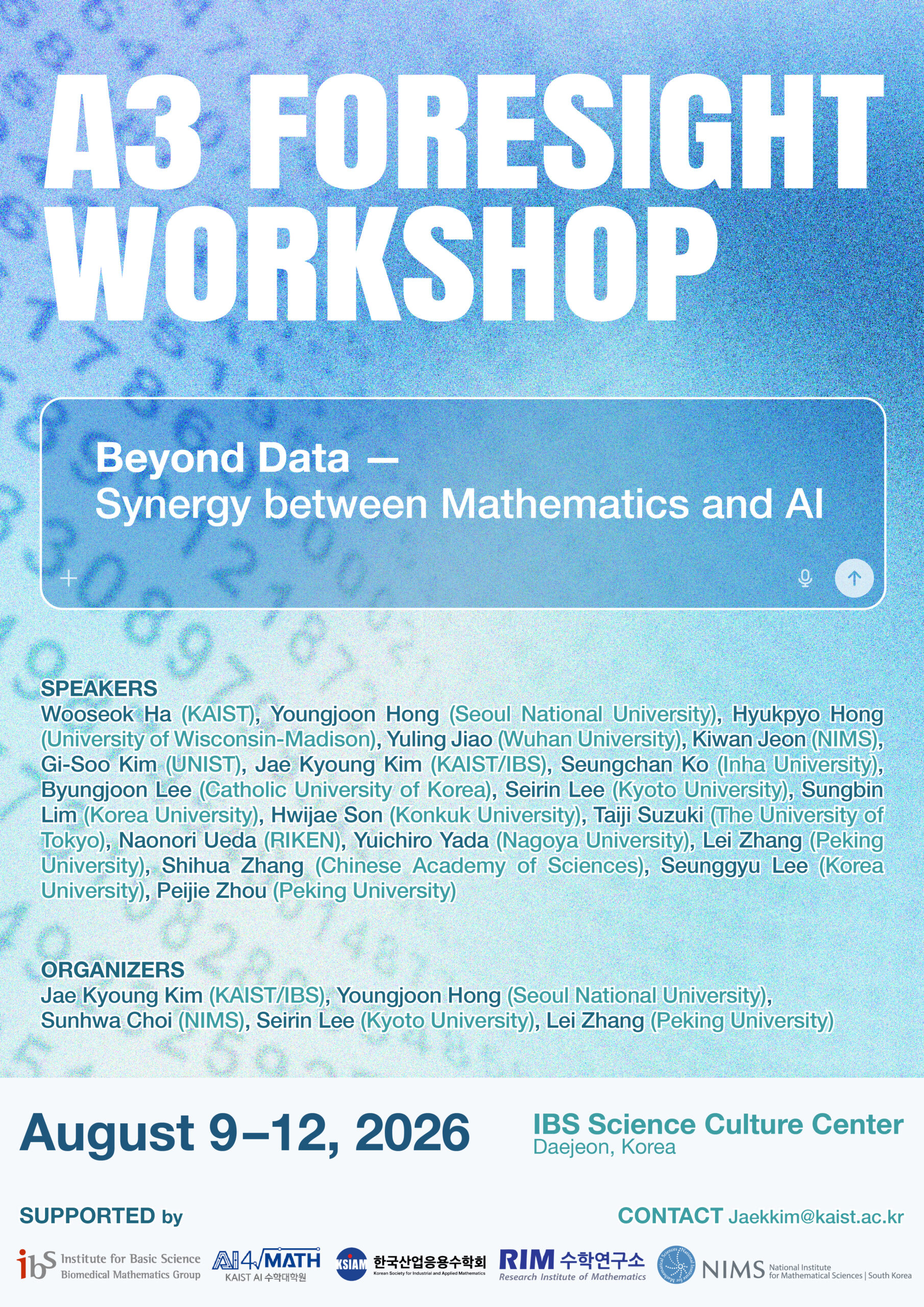
A3 Foresight Workshop 2026
Conference Webpage Link: https://sites.google.com/view/a3-foresight-workshop-2026/home
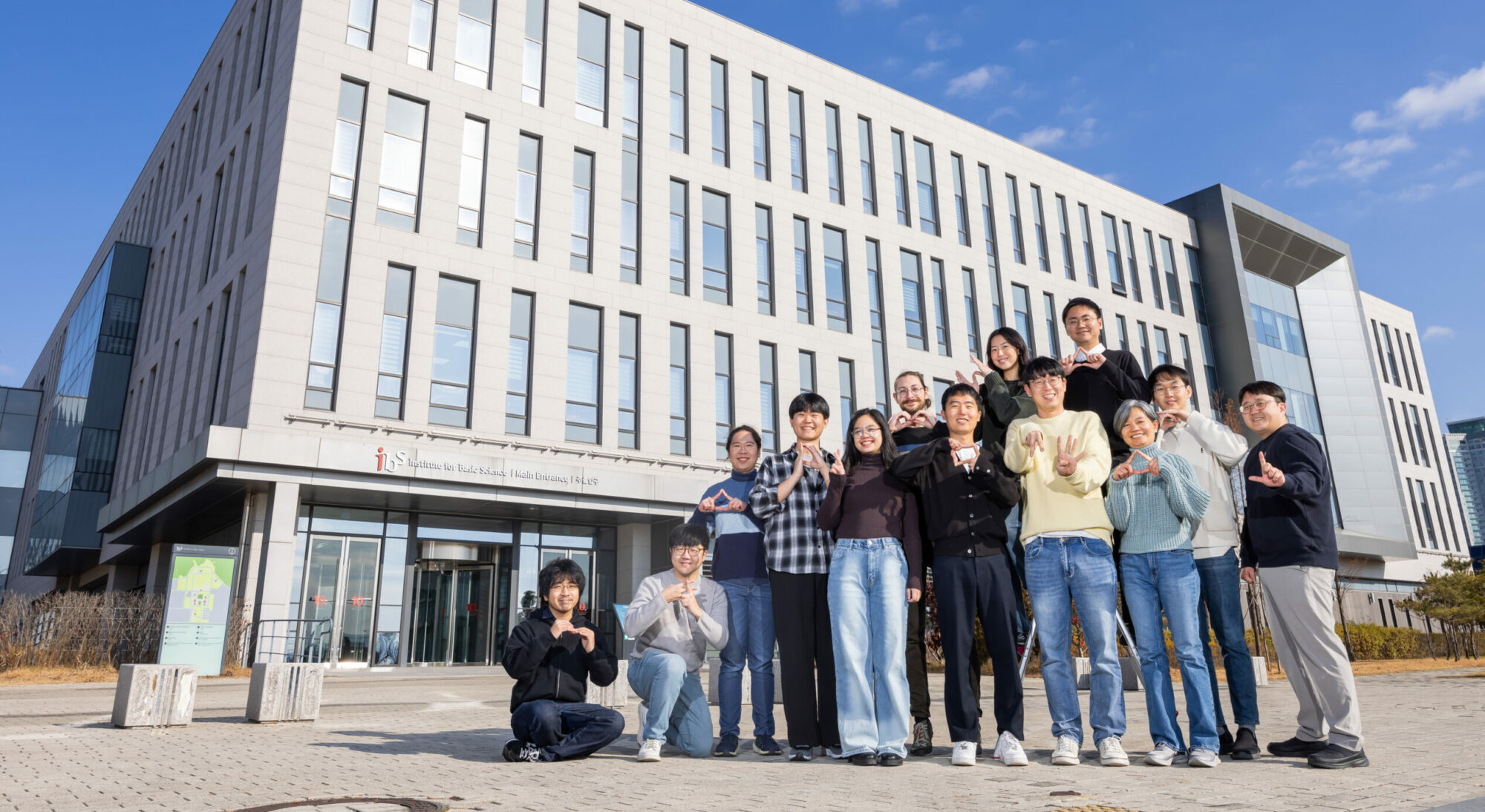

기초과학연구원 의생명수학그룹
Conference Webpage Link: https://sites.google.com/view/a3-foresight-workshop-2026/home
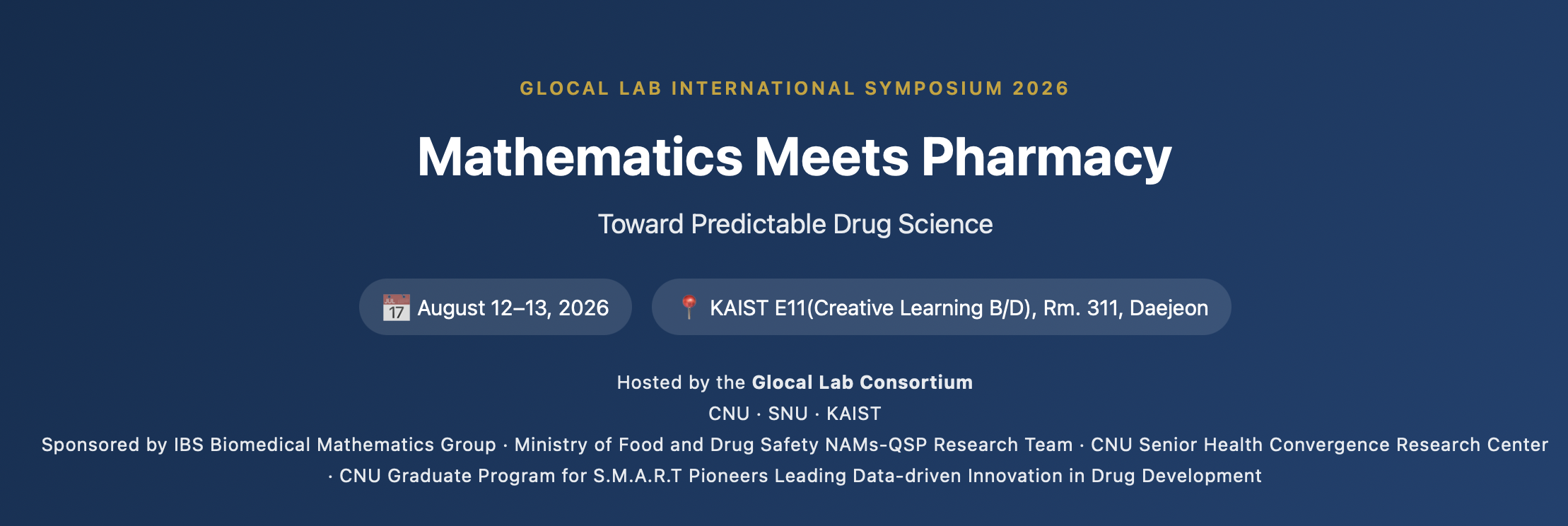
Conference Webpage Link: https://glocallab-symposium2026.netlify.app/
In this talk, we discuss the paper "Evolution of error correction through a need for speed" by Riccardo Ravasio et al., Science, 2026. Abstract: Kinetic proofreading is a class of error-correcting mechanisms in biology that expend energy to avoid mistakes during replication, transcription, and translation. Proofreading is typically assumed to evolve when selection for fidelity …

이번 세미나에서는 "조선이 만난 아인슈타인", "판타 레이" 등을 저술하신 민태기 소장님을 모시고 "수학이 공학의 언어라면"이라는 주제로 강연을 진행할 예정입니다.
In this talk, we discuss the paper "Dynamical Causality Under Latent Confounders for Biological Network Reconstruction" by Jinling Yang et al, IEEE Transactions on Pattern Analysis and Machine Intelligence (2026). Abstract: Causal interaction inference is prone to spurious causal interactions, due to the substantial confounders in a biological system. While many existing methods attempt to address …
In this talk, we discuss the paper "Towards a General Intelligence and Interface for Wearable Health Data" by Girish Narayanswamy et al., arXiv, 2026. Abstract: While ubiquitous wearable sensors capture a wealth of behavioral and physiological information, effectively transforming these signals into personalized health insights is challenging. Specifically, converting low-level sensor data into representations capable …

Biochemical assays have made outstanding progress to elucidate how cells sense and respond to stimuli, but mechanistic and parametric uncertainties preclude quantitative predictions for the full spatial, temporal, and heterogeneous responses of signal-activated gene expression. Stochastic models use random noise as an abstraction to account for these unknown or uncertain dynamics. When inferred from appropriate …
In this Journal club, we will discuss the paper "Identification of predictive subphenotypes for clinical outcomes using real world data and machine learning", Weishen Pan et al., Nature Communications, 2025. Abstract: Predicting treatment response is an important problem in real-world applications, where the heterogeneity of the treatment response remains a significant challenge in practice. Unsupervised …
In this talk, we discuss the paper "Learning to learn ecosystems from limited data" by Zheng-Meng Zhai et al., PNAS, 2025. Abstract: A fundamental challenge in developing data-driven approaches to ecological systems for tasks such as state estimation and prediction is the paucity of the observational or measurement data. For example, modern machine-learning techniques such …

Reservoir computing has recently been exploited to solve a variety of challenging problems in complex nonlinear dynamical systems. The speaker will review some recent works from his group in this area: predicting tipping point and critical transitions, digital twins of nonlinear dynamical systems, parameter and trajectory tracking, and associative memory for complex dynamical patterns. Some …

Modern computing has been fundamentally built upon the separation of hardware and software. This separation has enabled programs to be replicated and executed on interchangeable hardware, making computation effectively “immortal.” In contrast, recent approaches to physical computing seek to exploit the intrinsic dynamics of physical systems as computational resources, thereby crossing the abstraction layers that …
In this talk, we discuss the paper "Ptolemy's Equant Equates to a Universal Dynamical Clock via Machine Learning" by Jindong Zhang et al., arXiv, 2026. Abstract: Oscillatory dynamics arise ubiquitously in nonlinear systems, yet identifying a physically interpretable phase and phase dynamics in nonlinear, high-dimensional oscillations remains a central unresolved problem. Here we establish the …