
Skip to content
Biomedical Mathematics Group

Biomedical Mathematics Group

기초과학연구원 의생명수학그룹

  • Home
  • About
  • People
    • Members
    • Collaborators
    • Former Members
    • Visitor
    • Interns
  • Research
    • Research Aim
    • Papers
    • Software
    • Awards
  • Events
    • Seminar
      • Biomedical Mathematics Online Colloquium
      • Biomedical Mathematics Seminar
      • Journal Club
      • Lunch Lab Meeting Seminar
      • Previous Biomedical Mathematics Online Colloquiums
    • Workshops and Conferences
  • News
  • Visiting
  • Job & Application
    • Job opening
    • 2024 Call for IBS Young Scientist Fellowship (Due: December 23, 2024)
    • Graduate Student Internship (Due: Nov 20, 2025)
    • Undergraduate Student Internship (Due: Nov 20, 2025)
12 events found.

Events Search and Views Navigation

Event Views Navigation

  • List
  • Month
  • Day
Today
  • September 2023

  • Wed 6
    September 6, 2023 @ 4:00 pm - 5:00 pm KST

    Jonathan Rubin, Multiple timescale modeling for neural systems

    B378 Seminar room, IBS 55 Expo-ro Yuseong-gu, Daejeon, Korea, Republic of

    Abstract Mathematical models of biological systems, including neurons, often feature components that evolve on very different timescales. Mathematical analysis of these multi-timescale systems can be greatly simplified by partitioning them into subsystems that evolve on different time scales. The subsystems are then analyzed semi-independently, using a technique called fast-slow analysis. I will briefly describe the …

    Continue Reading
  • Fri 8
    September 8, 2023 @ 2:00 pm - 4:00 pm KST

    Dongju Lim, Exact solution of a three-stage model of stochastic gene expression including cell-cycle dynamics

    B378 Seminar room, IBS 55 Expo-ro Yuseong-gu, Daejeon, Korea, Republic of

    We will discuss about “Exact solution of a three-stage model of stochastic gene expression including cell-cycle dynamics”, Wang, Yiling, et al., bioRxiv (2023): 2023-08.   Abstract The classical three-stage model of stochastic gene expression predicts the statistics of single cell mRNA and protein number fluctuations as a function of the rates of promoter switching, transcription, translation, …

    Continue Reading
  • Thu 14
    September 14, 2023 @ 4:00 pm - 5:30 pm KST

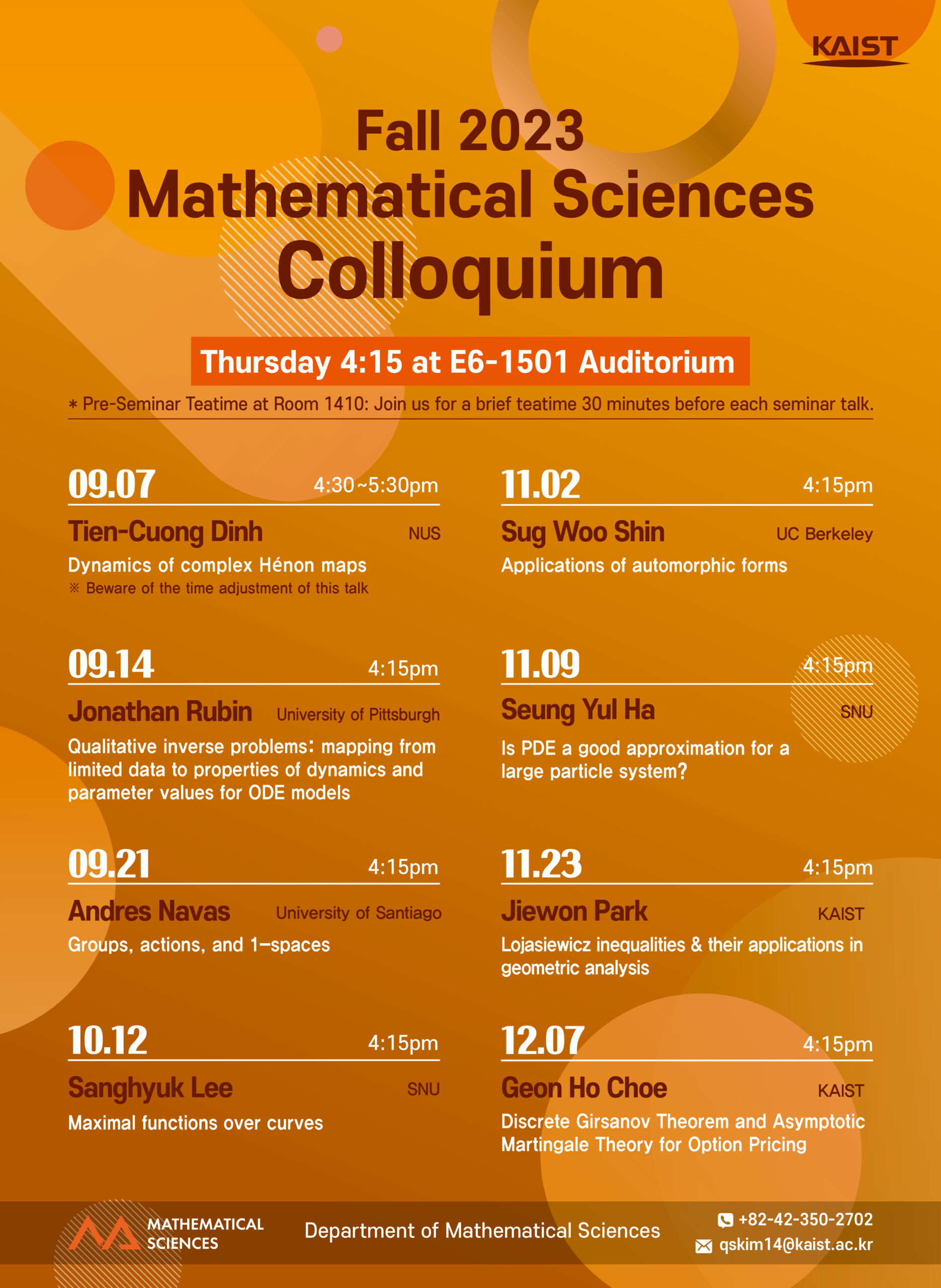
    Jonathan Rubin, Qualitative inverse problems: mapping from limited data to properties of dynamics and parameter values for ODE models

    KAIST E6-1 1501 Auditorium 291 Daehak-ro, Yuseong-gu, Daejeon, Korea, Republic of
  • Fri 15
    September 15, 2023 @ 2:00 pm - 4:00 pm KST

    Eui Min Jung, Antithetic proportional-integral feedback for reduced variance and improved control performance of stochastic reaction networks

    B378 Seminar room, IBS 55 Expo-ro Yuseong-gu, Daejeon, Korea, Republic of

    We will discuss about “Antithetic proportional-integral feedback for reduced variance and improved control performance of stochastic reaction networks ”,Briat, Corentin, Ankit Gupta, and Mustafa Khammash., Journal of The Royal Society Interface 15.143 (2018): 20180079 Abstract The ability of a cell to regulate and adapt its internal state in response to unpredictable environmental changes is called …

    Continue Reading
  • Mon 18
    September 18, 2023 @ 4:00 pm - 5:00 pm KST

    Balazs Erdos, Quantifying the dynamics of postmeal metabolism: Inference from challenge test data

    B378 Seminar room, IBS 55 Expo-ro Yuseong-gu, Daejeon, Korea, Republic of
  • Wed 20
    September 20, 2023 @ 4:00 pm - 5:00 pm KST

    Sebastian Walcher, Reaction networks: Reduction of dimension and critical parameters

    ZOOM ID: 997 8258 4700 (Biomedical Mathematics Online Colloquium) (pw: 1234)

    Abstract: Typically, the mathematical description of reaction networks involves a system of parameter-dependent ordinary differential equations. Generally, one is interested in the qualitative and quantitative behavior of solutions in various parameter regions. In applications, identifying the reaction parameters is a fundamental task. Reduction of dimension is desirable from a practical perspective, and even necessary when …

    Continue Reading
  • Fri 22
    September 22, 2023 @ 2:00 pm - 4:00 pm KST

    Yun Min Song, A data-driven approach for timescale decomposition of biochemical reaction networks

    B378 Seminar room, IBS 55 Expo-ro Yuseong-gu, Daejeon, Korea, Republic of

    We will discuss about “A data-driven approach for timescale decomposition of biochemical reaction networks”, Amir Akbari, Zachary B. Haiman, Bernhard O. Palsson, bioRxiv (2023) Abstract Understanding the dynamics of biological systems in evolving environments is a challenge due to their scale and complexity. Here, we present a computational framework for timescale decomposition of biochemical reaction …

    Continue Reading
  • Tue 26
    September 26, 2023 @ 4:00 pm - 5:00 pm KST

    Jonathan Rubin, Qualitative inverse problems: mapping from limited data to properties of dynamics and parameter values for ODE models

    B378 Seminar room, IBS 55 Expo-ro Yuseong-gu, Daejeon, Korea, Republic of
  • October 2023

  • Fri 6
    October 6, 2023 @ 2:00 pm - 4:00 pm KST

    Olive Cawiding, Power spectral estimate for discrete data

    B378 Seminar room, IBS 55 Expo-ro Yuseong-gu, Daejeon, Korea, Republic of

    We will discuss about “Power spectral estimate for discrete data”, Nobert Marwan and Tobias Braun, Chaos (2023).   Abstract The identification of cycles in periodic signals is a ubiquitous problem in time series analysis. Many real-world datasets only record a signal as a series of discrete events or symbols. In some cases, only a sequence …

    Continue Reading
  • Tue 17
    October 17, 2023 - October 18, 2023

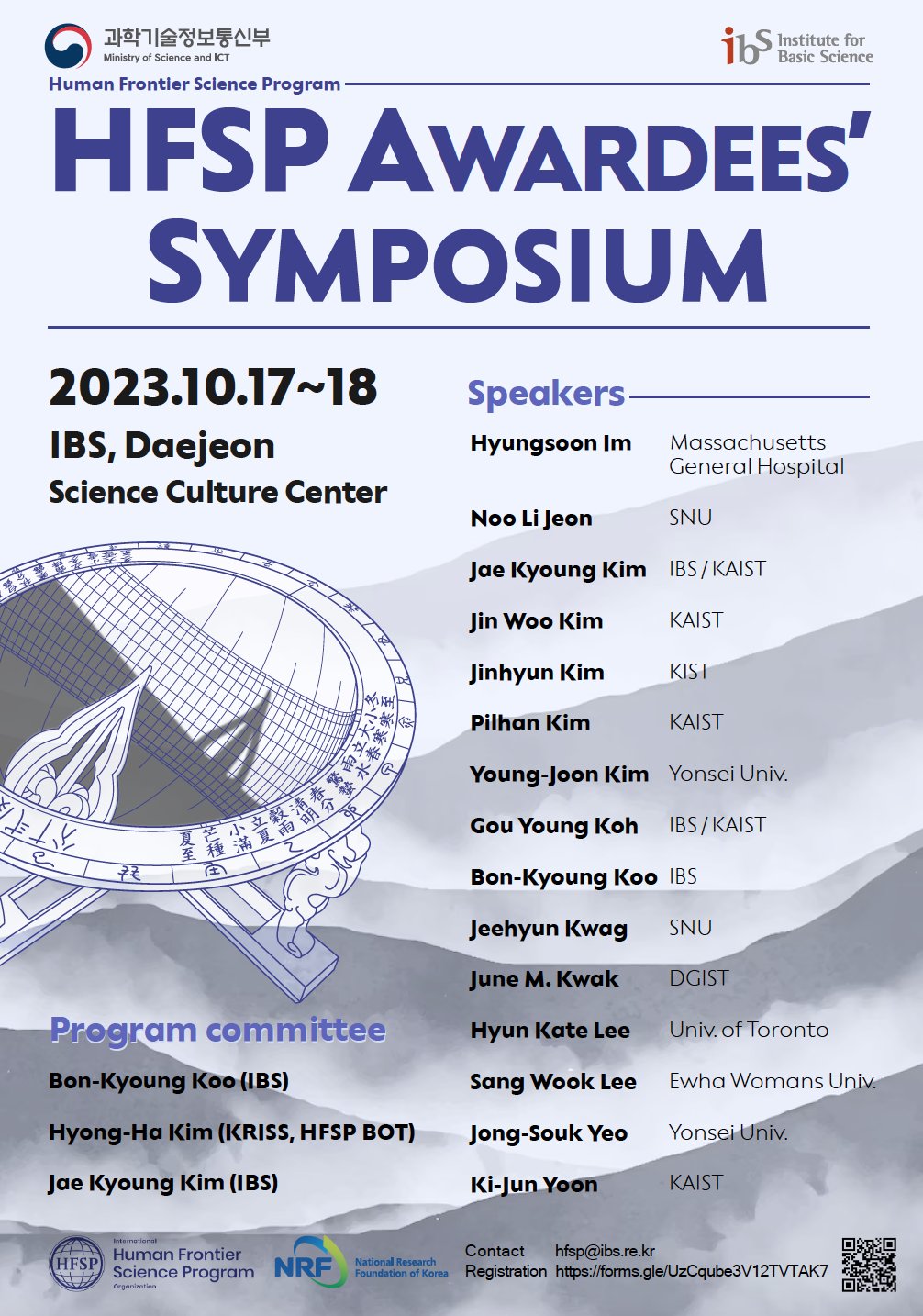
    Human Frontier Science Program Awardees’ Symposium

    IBS 55 Expo-ro Yuseong-gu, Daejeon, Daejeon, Korea, Republic of
  • Fri 20
    October 20, 2023 @ 11:00 am - 12:00 pm KST

    Tetsuya J. Kobayashi, Optimality of Biological Information Processing

    ZOOM ID: 997 8258 4700 (Biomedical Mathematics Online Colloquium) (pw: 1234)

    Abstract: Almost all biological systems possess the ability to gather environmental information and modulate their behaviors to adaptively respond to changing environments. While animals excel at sensing odors, even simple bacteria can detect faint chemicals using stochastic receptors. They then navigate towards or away from the chemical source by processing this sensed information through intracellular …

    Continue Reading
  • Fri 20
    October 20, 2023 @ 2:00 pm - 4:00 pm KST

    Hyeontae Jo, AutoScore:A Machine Learning–Based Automatic Clinical Score Generator and Its Application to Mortality Prediction Using Electronic Health Records

    B378 Seminar room, IBS 55 Expo-ro Yuseong-gu, Daejeon, Korea, Republic of

    We will discuss about "AutoScore:A Machine Learning–Based Automatic Clinical Score Generator and Its Application to Mortality Prediction Using Electronic Health Records", Xie, Feng, et al., JMIR medical informatics 8.10 (2020): e21798. Abstract Background: Risk scores can be useful in clinical risk stratification and accurate allocations of medical resources, helping health providers improve patient care. Point-based scores …

    Continue Reading
  • Previous Events
  • Today
  • Next Events
  • Google Calendar
  • iCalendar
  • Outlook 365
  • Outlook Live
  • Export .ics file
  • Export Outlook .ics file
IBS 의생명수학그룹 Biomedical Mathematics Group
기초과학연구원 수리및계산과학연구단 의생명수학그룹
대전 유성구 엑스포로 55 (우) 34126
IBS Biomedical Mathematics Group (BIMAG)
Institute for Basic Science (IBS)
55 Expo-ro Yuseong-gu Daejeon 34126 South Korea
Copyright © IBS 2021. All rights reserved.