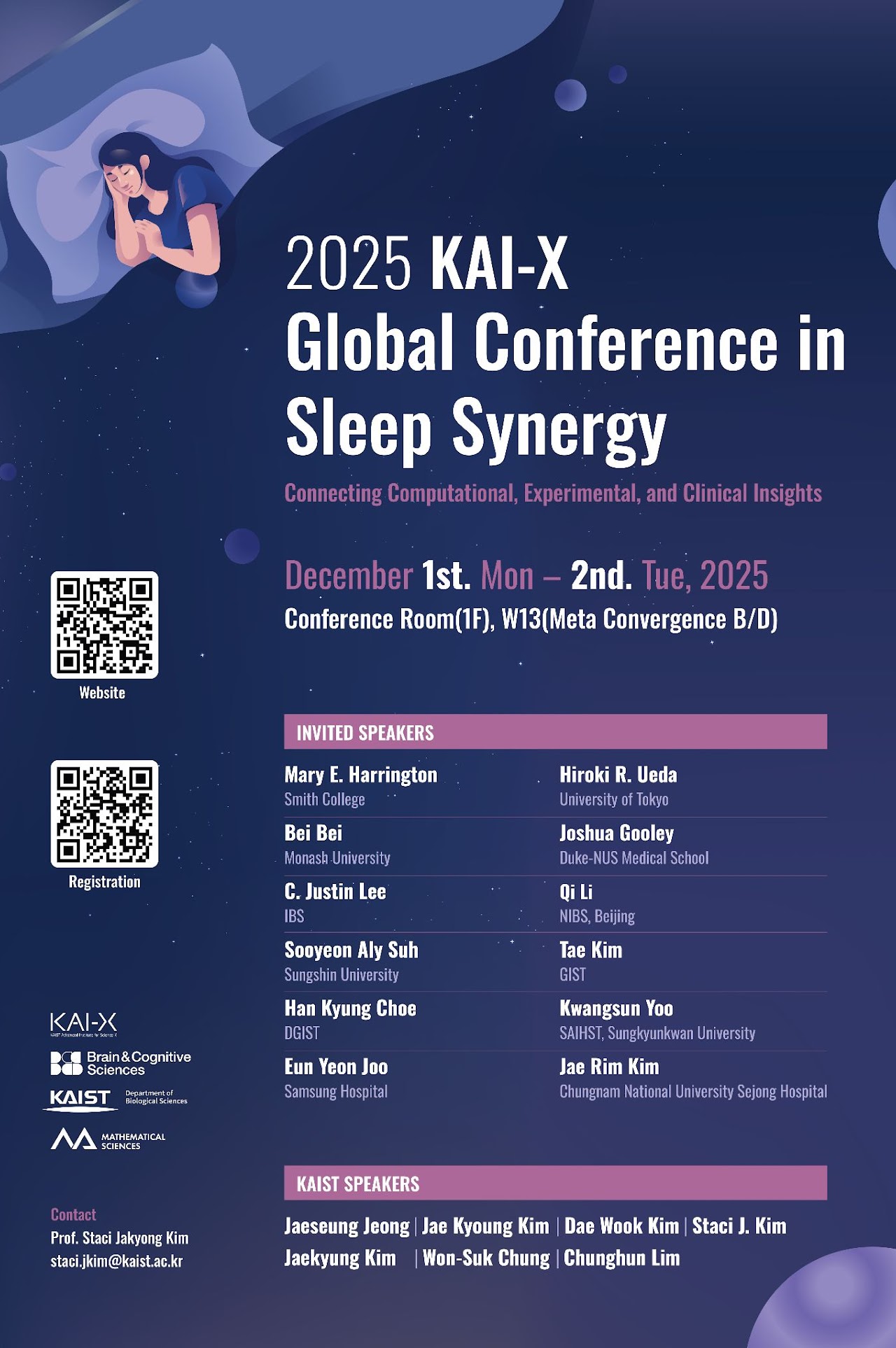
2025 KAI-X Global Conference in Sleep Synergy
Conference Webpage Link: https://sites.google.com/view/2025-kai-x-sleep-synergy/home


기초과학연구원 의생명수학그룹
Conference Webpage Link: https://sites.google.com/view/2025-kai-x-sleep-synergy/home

Abstract Many natural systems exhibit complex dynamics and are prone to sudden changes or ‘regime shifts’. At the same time, many of these systems are sparsely observed posing considerable challenges for modeling and control. Here I will describe recent developments in empirical dynamic modeling (EDM) for inference of bifurcations and anticipation of unseen dynamical regimes …
In this talk, we discuss the paper "Causal disentanglement for single-cell representations and controllable counterfactual generation" by Yicheng Gao et al., Nature Communications, 2025. Abstract Conducting disentanglement learning on single-cell omics data offers a promising alternative to traditional black-box representation learning by separating the semantic concepts embedded in a biological process. We present CausCell, which …
In this talk, we discuss the paper "N-BEATS: Neural basis expansion analysis for interpretable time series forecasting" by B. Oreshkin et al., ICLR, 2020. Abstract We focus on solving the univariate times series point forecasting problem using deep learning. We propose a deep neural architecture based on backward and forward residual links and a very …
Classical machine learning models are typically trained under the assumption that the training (source) and test (target) data are drawn from the same distribution. However, real-world data are rarely clean or consistent, and distribution shifts between the source and target domains are ubiquitous. Despite its importance, addressing distribution shifts is highly difficult. The fundamental challenge …
Recent advances in data science have expanded the scope of data analysis beyond prediction accuracy toward interpretability, causal understanding, and generalizable learning across complex data structures. This lecture introduces three emerging methodological approaches that can be directly leveraged in modern data analysis workflows. First, the lecture presents explainable artificial intelligence (XAI) techniques, focusing on SHAP …
Mathematical modeling provides essential quantitative insights that accelerate drug and cell therapy development. In this presentation, we utilize kinetic frameworks to optimize the design of molecular glues by elucidating their biophysical determinants and identify a key target for NK cell-mediated immunotherapy through systematic data analysis. Collectively, we demonstrate how mathematical strategies can effectively guide and …
In this talk, we discuss the paper "Seasonal timing and interindividual differences in shiftwork adaptation" by R. Kim et al., npj digital medicine, 2025. Abstract Millions of shift workers in the U.S. face an increased risk of depression, cancer, and metabolic disease, yet individual responses to shift work vary widely. We find that a conserved …
In this talk, we discuss the paper "scPPDM: A Diffusion Model for Single-Cell Drug-Response Prediction" by Z. Liang et al., arxiv, 2025. Abstract This paper introduces the Single-Cell Perturbation Prediction Diffusion Model (scPPDM), the first diffusion-based framework for single-cell drug-response prediction from scRNA-seq data. scPPDM couples two condition channels, pre-perturbation state and drug with dose, …
Complex diseases, such as cancer, sarcopenia, and immune disorders, arise from abnormalities in multiple genes and pathways, posing significant challenges to conventional single-target drug discovery strategies. To address this, we developed a perturbome-based analytical framework that integrates transcriptomic signatures, network pharmacology, and machine learning to identify effective therapeutic candidates. Central to this approach is the …
In this talk, we discuss the paper, "Quantifying interventional causality by knockoff operation" by Xinyan Zhang and Luonan Chen, Science Advances, 2025. Abstract Causal inference between measured variables is crucial to understand the underlying mechanism of complex biological processes at a network level but remains challenging in computational biology. We propose an innovative causal criterion, …
In this talk, we discuss the paper, "A wearable-based aging clock associates with disease and behavior" by A. C. Miller et al., Nature Comm, 2025. Abstract Aging biomarkers play a vital role in understanding longevity, with the potential to improve clinical decisions and interventions. Existing aging clocks typically use blood, vitals, or imaging collected in …